An LED screen rental is usually quoted as a rate per square meter (or per panel) per show day, plus separate lines for the video processor, ground support or rigging, transport, build crew and an on-site technician. For a one-day event those fixed lines often add up to as much as the panels themselves, so the price per square meter falls sharply as the wall gets bigger or the hire runs longer. The three specifications that move the panel rate most are pixel pitch, indoor or outdoor brightness, and how many days the screen stays on site.
Sources used: EA500H9 model tables and service features
This guide is written for event planners and corporate event organizers who hire an LED wall a few times a year and want to read a quote with confidence. It explains each line of a typical hire quote, how to choose screen size, pitch and brightness for your audience, and what to confirm before you sign.
The last part covers the question every frequent renter eventually asks: at what point would owning the screen cost less than renting it? We use published panel prices and a simple break-even method so you can test that against the quotes you already have.
1. What an LED Screen Rental Quote Includes
A rental quote for an LED video wall bundles hardware, services and risk. Suppliers present them differently, which is why two quotes for “a 5 × 3 m screen” can look far apart even when the panels are similar. Break every quote into the same lines before you compare them.
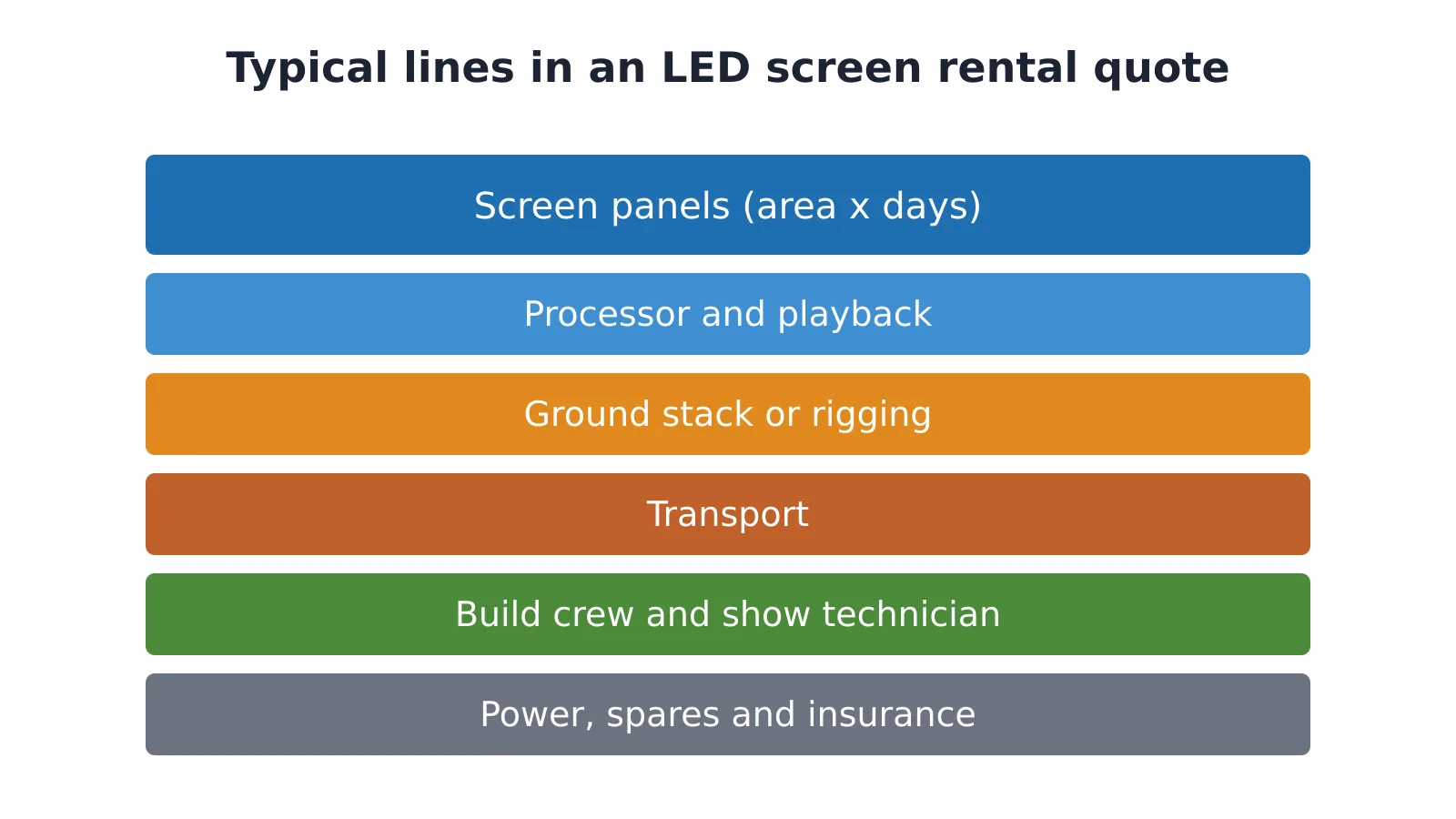
Illustrative diagram: the usual cost lines in an LED screen hire quote. Bar order follows the order in which most quotes list them, not their size.
01. Screen panels: area times days
The panel line is the screen area (or the number of cabinets) multiplied by a day rate. Rental cabinets usually come in 500 × 500 mm (19.7 × 19.7 in) or 500 × 1000 mm (19.7 × 39.4 in) sizes, so a wall is built in 0.5 m steps. A 4 m × 2.5 m wall is 10 m² (108 sq ft) and 40 square cabinets; a 4 m × 2.25 m wall is not possible with that grid.
Many suppliers discount the second and later days of the same booking because the build and transport are already paid for. Ask how they charge for rehearsal days, set-up days when the screen is lit but not “in show,” and days the wall stands dark.
02. Processor, sending equipment and playback
Every LED wall needs a video processor or controller that takes your HDMI or SDI source and maps it onto the panels. The quote should state the processor, how many inputs it takes, whether it scales the image, and whether a backup unit is included. Media servers, laptops, switchers and cameras are often extra; if your AV production company supplies them, say so, or you may pay twice.
03. Ground stack, truss or flown rigging
Small walls can stand on a ground-stack frame with rear bracing. Larger walls, or walls above a stage, hang from truss or venue rigging points. Structure is a separate line and is often priced by the meter of frame or by the number of rigging points. Outdoor walls add ballast and wind bracing. If the venue requires a rigging plan, a structural calculation or a certified rigger, check who provides it.
04. Transport, build crew and show technician
Transport depends on distance, truck size and access (loading dock, stairs, lift, parking restrictions). Build crew is charged per person per call, with minimum hours, and overnight or weekend calls cost more. A show technician stays with the screen during the event to swap faulty modules, adjust brightness and manage the processor. For anything more than a small trade-show wall, plan on having one.
| Quote line | What it covers | How it is usually priced | Question to ask |
|---|---|---|---|
| Screen panels | Cabinets, modules, power and data cables | Per m² or per cabinet, per day | What is the rate for day two and later? |
| Processing | Video processor, sending cards, backup | Per system, per day | Is a backup processor included? |
| Structure | Ground stack, truss, hanging bars, ballast | Per system or per meter, per booking | Who supplies drawings and load calculations? |
| Transport | Truck, driver, fuel, tolls | Per trip or per km | Are both delivery and collection included? |
| Crew | Build, strike and show technician | Per person per call, minimum hours | What happens if the call runs late? |
| Power and spares | Distribution boxes, cabling, spare modules | Often bundled, sometimes separate | Does the venue or the supplier provide power? |
| Insurance and damage | Cover while the wall is on site | Percentage of hire or venue policy | Who pays for a damaged module? |
2. What Drives the Price of an LED Wall Rental
Once the quote is split into lines, the panel rate of an LED screen rental is driven mainly by pitch, brightness and duration, while the fixed lines are driven by location, timing and the build.
01. Pixel pitch and viewing distance
Pixel pitch is the distance between LED centers in millimeters. A finer pitch means more LEDs per square meter, sharper close-up viewing and a higher rate. The common rule of thumb is that the nearest comfortable viewing distance in meters is roughly the pitch in millimeters, and two to three times that distance gives a fully smooth image. Treat this as an approximation: text-heavy slides need more margin than video.
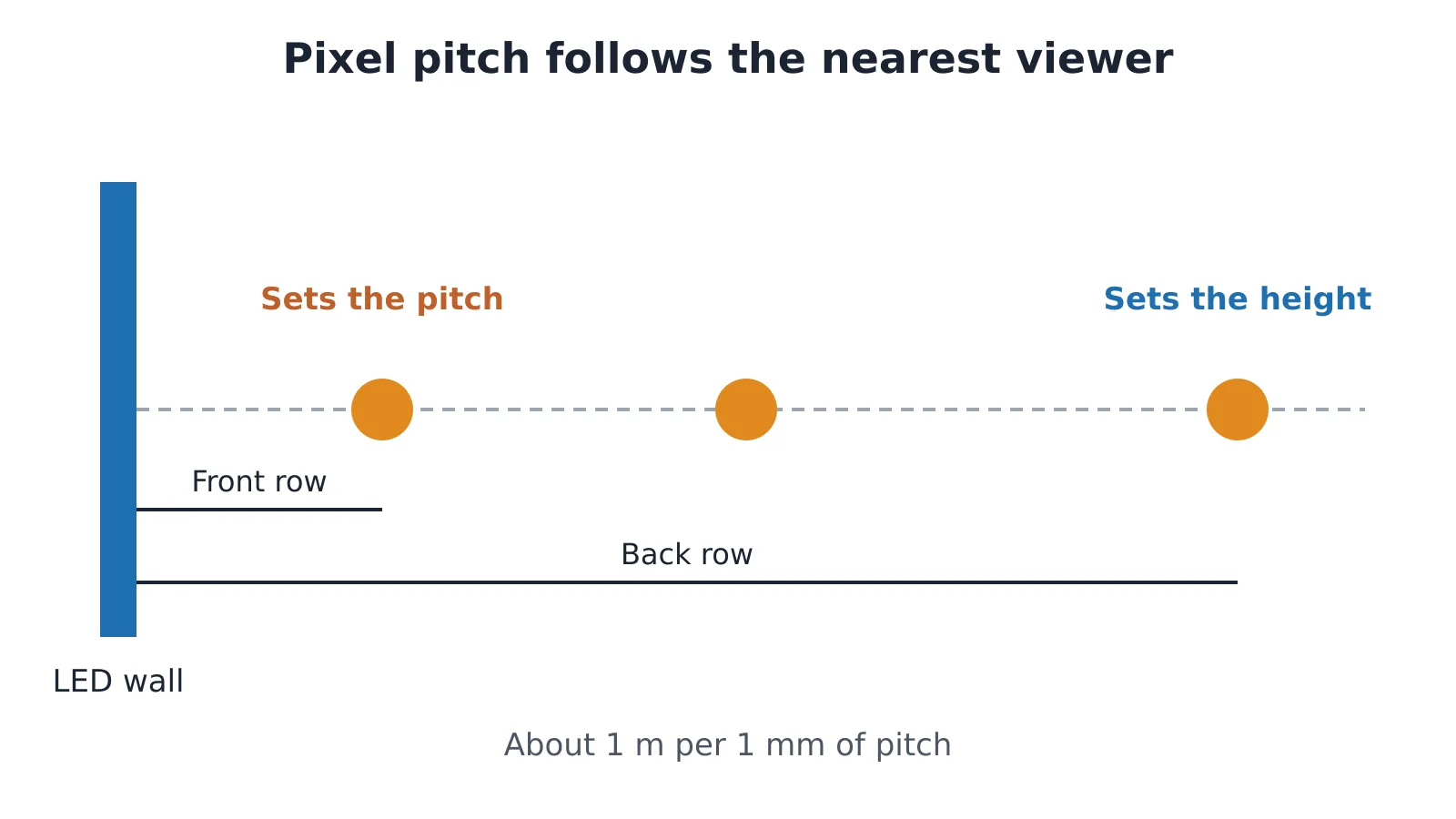
Illustrative diagram: the front row decides the pixel pitch; the back row decides how tall the image must be.
| Pixel pitch | Nearest comfortable viewing distance (approx.) | Typical event use |
|---|---|---|
| P1.9 to P2.0 | 2 m (6.6 ft) | Close-up corporate stages, studios, camera-heavy shows |
| P2.6 | 2.5 to 3 m (8 to 10 ft) | Conference stages, product launches, exhibition stands |
| P2.9 to P3.9 | 3 to 4 m (10 to 13 ft) | Concerts, larger halls, outdoor stages with distant crowds |
| P4.8 and coarser | 5 m (16 ft) and more | Outdoor festivals and sports viewed from far away |
Choosing a finer pitch than the audience needs raises the price without a visible benefit. Choosing a coarser one shows up as visible pixels for the front rows and, on camera, as moiré.
02. Indoor or outdoor brightness
Indoor rental panels typically run at 600 to 1,500 nits (cd/m²), which is more than enough for a ballroom or a theater; most indoor shows run at a fraction of full brightness. Outdoor panels in direct daylight need roughly 4,500 nits or more, and they need an ingress rating such as IP65 per IEC 60529 on the front. Outdoor cabinets cost more to buy and to maintain, so expect a higher LED wall hire rate for the same area.
03. Event length, number of days and travel
A one-day hire carries the full cost of transport, build and strike. A three-day conference spreads the same fixed lines over three show days. That is why the per-day cost of an LED display hire drops with longer bookings even before any discount. If you have several events in one region, ask whether the supplier can keep the wall built or stored nearby between them.
04. Date, location and lead time
Peak season, public holidays and large city-wide events tie up rental inventory, and late bookings can mean paying for panels moved in from farther away. Venues with tight load-in windows need a bigger crew to build in less time. Remote sites add travel time, per diems and sometimes a generator.
3. Sizing the Screen for Your Event
For any LED screen rental, size the image from the back row, then fit it to the cabinet grid, then check the venue.
01. Image height from the farthest viewer
A common AV planning figure is that image height should be about one-sixth of the distance to the farthest viewer for general video and graphics, and closer to one-quarter for detailed text or spreadsheets. A room whose back row sits 18 m (59 ft) from the stage therefore needs an image about 3 m (9.8 ft) tall for presentations. These are guidelines, not standards; a keynote with large type can work with a smaller screen.
02. Aspect ratio and the cabinet grid
Most content is 16:9, but a rental wall is built from 0.5 m steps, so you rarely hit 16:9 exactly. A 4 m × 2.5 m wall is 16:10; 6 m × 3.5 m is about 12:7. Agree the final pixel resolution with the supplier before anyone designs graphics, and ask for a pixel map. Content made at the wrong resolution is either scaled (softer) or letterboxed.
03. Venue checks: weight, power and access
LED cabinets are heavy in aggregate. A 10 m² indoor wall can weigh around 300 kg (660 lb) before frames and cables, and an outdoor wall of 20 m² can pass 600 kg (1,320 lb). Check floor loading, rigging limits and the route from the loading dock to the stage. For power, ask the supplier for the maximum and average draw of the wall and the type of connection required. In Europe that is usually 220 to 240 V single-phase or 400 V three-phase supplies; in North America, 110 to 120 V circuits limit how many panels share one feed, so larger walls often need 208 V supplies.
4. Rent or Buy: Where the Break-Even Sits
An LED screen rental makes sense when you use a screen occasionally, need different sizes for different events, or want the supplier to carry the risk of damage and repairs. Buying starts to make sense when the same wall goes out often enough that the cumulative day rates pass the cost of owning it.
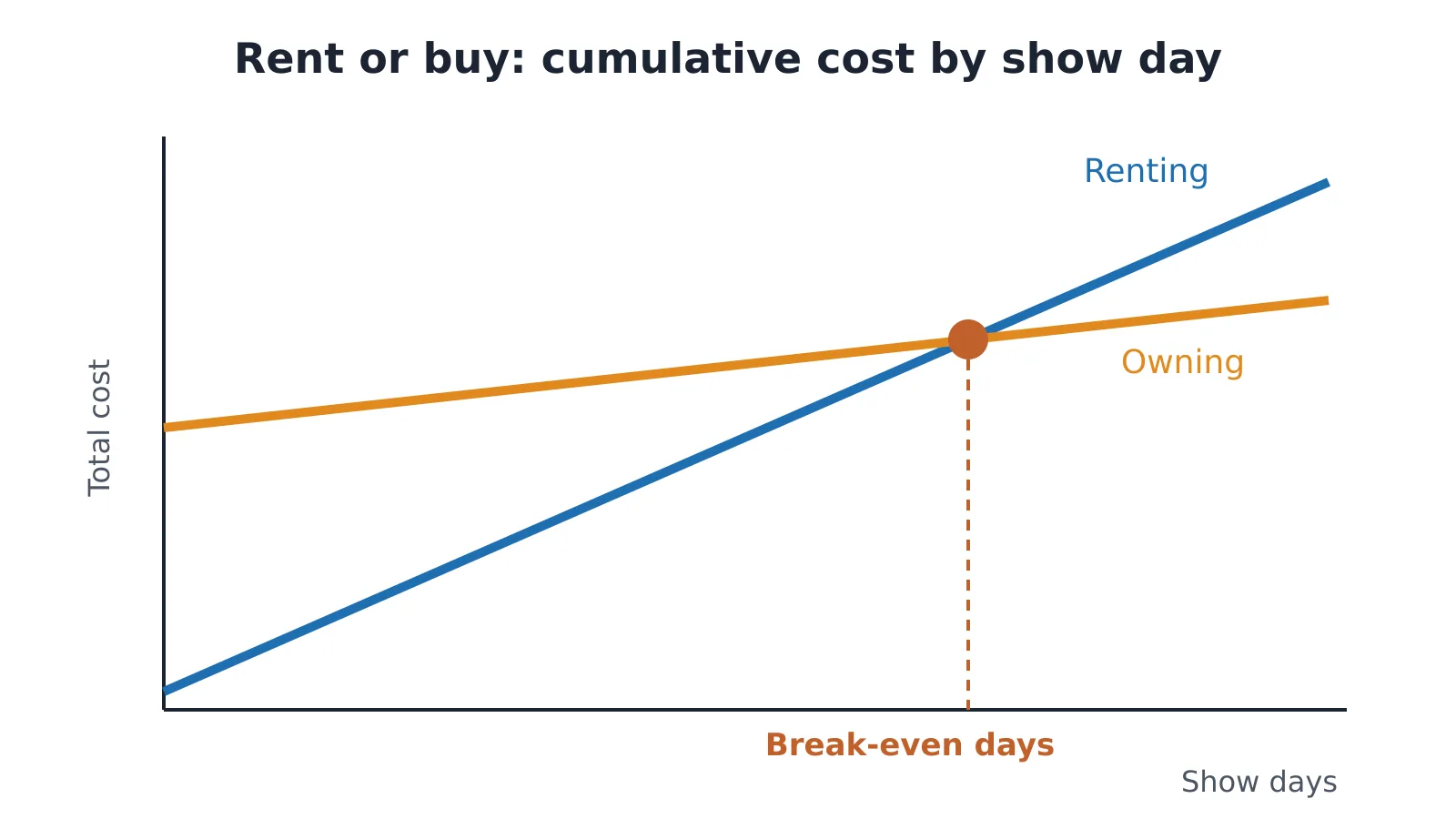
Illustrative diagram: renting has no upfront cost but rises with every show day; owning starts high and rises slowly.
01. The break-even formula
Estimate the break-even point in show days as:
Break-even days = (purchase cost + first-year ownership costs) ÷ (rental cost per show day − your own running cost per show day)
Use the full rental cost per show day from your past quotes, including processing, crew and transport that you would no longer pay for. Then subtract what you would still spend on each event when you own the wall: your own crew time, transport, consumables and wear.
02. Ownership costs that renters never see
| Ownership cost | Why it matters |
|---|---|
| Video processor and backup | Required for every show; not part of a panel price |
| Flight cases | Protect cabinets in transit; usually one case per four to eight cabinets |
| Frames, truss or ground support | Needed for every build; outdoor walls also need ballast |
| Spare modules and power supplies | Many owners keep a few percent of the wall as spares |
| Storage and handling | A warehouse or secure room, plus loading equipment |
| Trained crew | Someone must build, map and troubleshoot the wall |
| Insurance and repairs | Accidental damage is now your risk |
| Depreciation and resale | Rental panels lose value as finer pitches become common |
As a rough guide, ownership is worth testing when the same wall size goes out on several dozen show days a year and you already have crew and storage. If you need a 3 m wall in March and a 10 m wall in June, renting keeps that flexibility. The lease, purchase and rental budget guide compares financing options in more detail.
5. Example Configurations and What They Cost to Own
To give the break-even formula real numbers, we priced two common rental walls using the EagerLED EA500H9 rental cabinet, a 500 × 500 mm die-cast cabinet with magnetic front-access modules that event companies use for both indoor and outdoor builds. These are factory prices for the cabinets only; processing, cases, structure, shipping and import duties are separate.
01. Indoor conference wall: 4 m × 2.5 m, P2.6
An indoor P2.6 GOB EA500H9 cabinet is listed at US$260 per cabinet (US$1,040/m² per m²). The EA500H9-iP2.6 lists 750 nits brightness, a 7 kg (15.4 lb) cabinet weight and at least 3,840 Hz refresh, which suits stages that are filmed. Forty cabinets give a 4 m × 2.5 m wall at 1536 × 960 pixels, for a cabinet cost of US$10,400.
If your audience sits closer, the indoor P1.95 GOB EA500H9 cabinet is listed at US$328 per cabinet (US$1,312/m² per m²). For most conference rooms where the front row sits 3 m (10 ft) or more away, P2.6 is the better value.
02. Outdoor event wall: 6 m × 3.5 m, P3.91
For an outdoor stage, the EA500H9-OP3.91-16S is listed at US$213 per cabinet (US$852/m² per m²). It is rated at 4,800 nits with IP65 front and IP54 rear protection and weighs 7.5 kg (16.5 lb). Eighty-four cabinets build a 6 m × 3.5 m wall at 1536 × 896 pixels, for a cabinet cost of US$17,892.
03. Turning the cabinet cost into a break-even estimate
Take the cabinet cost above, add the ownership items from the table in section 4, and divide by what you currently pay per show day for a wall of the same size, minus your own running costs. If the result is a number of show days you would reach within two or three seasons, a purchase quote is worth requesting. If it is several years of bookings, keep renting. Event companies building a fleet can read the rental panel purchase cost guide for the wider budget.
6. What to Check Before You Sign a Rental Contract
Most problems with an LED wall rental come from details nobody wrote down. Use this checklist once, with the final quote, and get the answers in writing.
| Check | What to confirm |
|---|---|
| Pitch and brightness | Exact pitch, indoor or outdoor version and maximum nits match your venue |
| Camera performance | Refresh rate of at least 3,840 Hz if the screen will be filmed or streamed |
| Resolution and pixel map | Final pixel width and height, delivered before content production starts |
| Processing | Inputs, signal type (HDMI or SDI), scaling and a backup processor |
| Spares on site | Spare modules, power supplies and data cables kept at the screen |
| Power | Maximum and average draw, connector type and who supplies distribution |
| Structure | Ground stack or rigging drawings, ballast and wind limits for outdoor builds |
| Weather plan | Wind speed at which the wall is lowered or switched off, and who decides |
| Timing | Load-in, build, test, show and strike times, and overtime rates |
| Liability | Insurance, damage responsibility and cancellation terms |
Ask to see the actual panels lit before the event if the screen is large or the show is important. Check uniformity (no patchy cabinets), dead pixels and color at low brightness. If you are comparing two or three offers, our guide to comparing LED screen quotes line by line explains how to normalize them. For outdoor dates with rain in the forecast, read how to select rental cabinets for wet outdoor events.
Frequently Asked Questions
How much does it cost to rent an LED screen for one day?
A one-day hire costs the panel day rate plus the full fixed costs of transport, build, processing and crew, so short hires cost the most per square meter. Ask for the quote split into lines and compare the panel rate, the fixed lines and the rate for extra days separately.
Is it cheaper to rent or buy an LED video wall?
Renting is cheaper for occasional use or when the screen size changes between events. Buying is cheaper once your yearly show days pass the break-even point, which you can estimate by dividing the purchase and ownership costs by your current rental cost per show day.
What size LED screen do I need for an event?
Make the image roughly one-sixth as tall as the distance to the farthest viewer for video and graphics, and about one-quarter for detailed text. Then round to the 0.5 m cabinet grid and confirm the final pixel resolution with the supplier.
How far in advance should I book an LED wall hire?
Book as early as you can confirm the date; for large walls, outdoor events or peak season, many suppliers need several weeks to reserve inventory, plan structure and schedule crew. Last-minute bookings may still be possible but with less choice of pitch and size.
Do I need a technician with an LED screen on hire?
For anything beyond a small, self-contained display, yes. A technician monitors the processor, replaces faulty modules during the show and adjusts brightness as light changes, and most suppliers require one when their rigging is in use.
Can a rented LED screen be used outdoors in the rain?
Only if it is an outdoor version with front and rear ingress protection, such as IP65 front and IP54 rear, and the structure is designed for wind. Indoor panels must never be used in the rain, even under a temporary cover.
What resolution should content be for a rented LED display screen?
Make content at the wall’s exact pixel resolution, which depends on the pitch and cabinet count. A 4 m × 2.5 m P2.6 wall, for example, is 1536 × 960 pixels; request the pixel map from your supplier before design starts.
Getting an Accurate Quote for Your Event Screen
Whether you plan to keep renting or want to see what owning a wall would cost, the same details make a quote accurate: the screen width and height you need, the nearest and farthest viewing distances, indoor or outdoor use, how the screen will be mounted, how many show days a year you expect, and the delivery country. Send them through our quote request form and EagerLED’s team will reply with a cabinet layout, matching processing and a written scope you can set against your current rental quotes.
Prices are reference ex-factory prices from the EagerLED August 2026 price list, in US dollars, for the standard configuration. Final pricing is subject to a formal quotation.
Check the details
Sources & references
Source pages can change. Access dates record when they were consulted.
- EA500H9 model tables and service features Accessed 28 September 2026
Put these details into your project brief.
Tell EagerLED the application, destination and screen dimensions you have in mind.
Request a project quote