Design the curve and the module together
EagerLED’s flexible indoor LED modules use a soft panel construction for shaped display surfaces. The source describes magnetic retention and front removal, with several module footprints and pitch choices. These are module families for an integrated display, rather than a single finished screen with a fixed cabinet or overall size. Flexible module specifications.
A curved retail feature, an indoor column wrap or a reception display can use this type of panel, provided the supporting structure and approved bend arrangement suit the chosen module. Start with a drawing of the illuminated surface. Mark where a flat section becomes curved, where the image ends and how a technician reaches the panel edges.
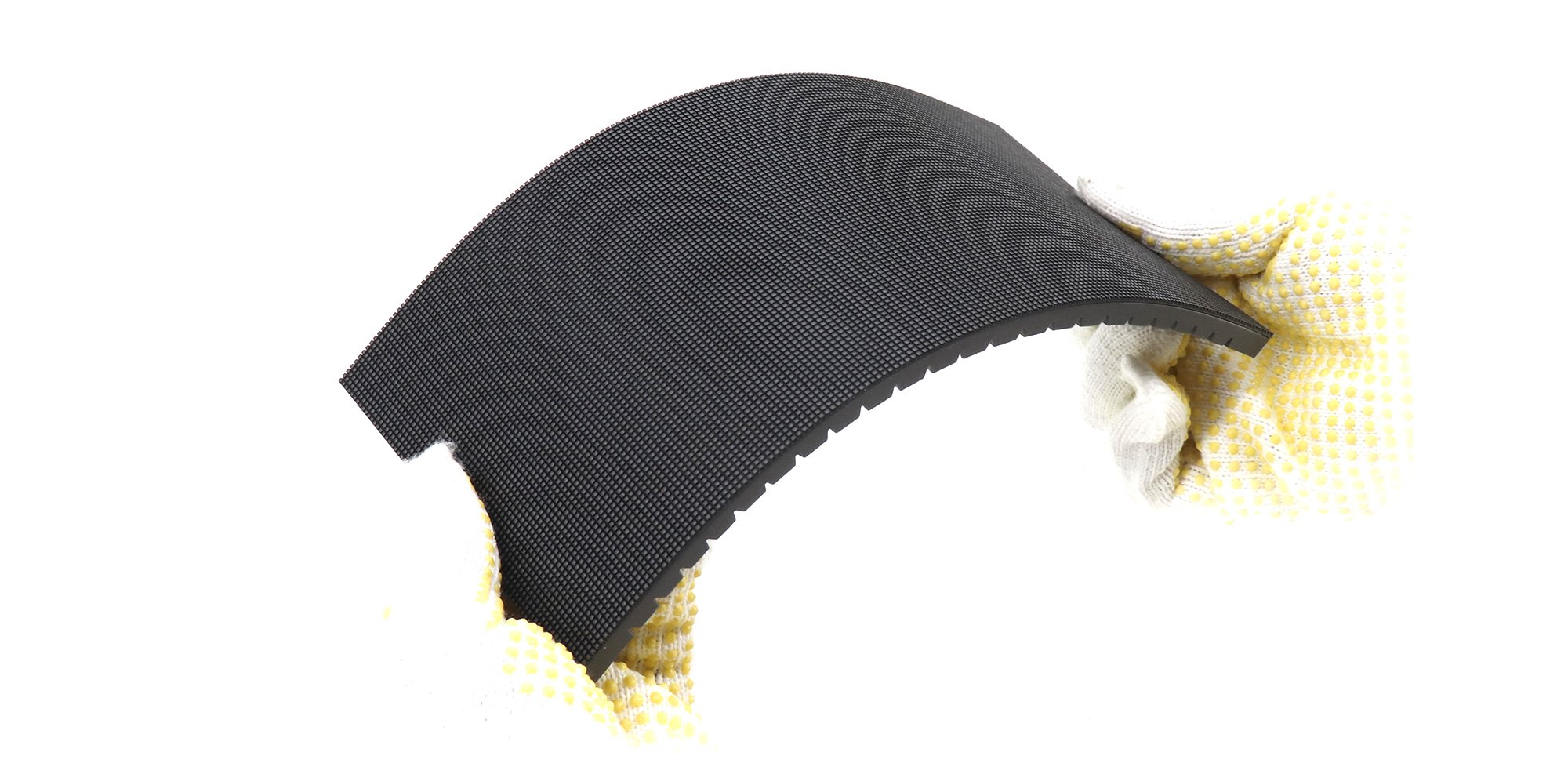
The source does not give a universal minimum bend radius or an unlimited number of bending cycles. Ask for the permitted curvature and bend direction for the actual module. An illustration of a panel held in a curve establishes the product’s flexible form; it does not supply the dimensions for every proposed shape. The flexible screen category helps compare module integration with complete shaped-screen products.
The 240 × 120 mm family
The 240 × 120 mm table contains two nominal P0.9 entries with different packaging and brightness, followed by SMD variants. Each row lists 3840 Hz refresh. Keep the P0.9 entries separate when evaluating a sample or requesting spares. 240 × 120 table.
| Pitch and construction | Module resolution | Driving duty | Listed brightness |
|---|---|---|---|
| P0.9 COB | 256 × 128 pixels | 1/64 | 800 nits |
| P0.9 IMD | 256 × 128 pixels | 1/64 | 650 nits |
| P1.25 SMD | 192 × 96 pixels | 1/48 | 650 nits |
| P1.579 SMD | 152 × 76 pixels | 1/38 | 700 nits |
| P1.875 SMD | 128 × 64 pixels | 1/32 | 700 nits |
| P2 SMD | 120 × 60 pixels | 1/30 | 700 nits |
| P2.5 SMD | 96 × 48 pixels | 1/24 | 700 nits |
| P3 SMD | 80 × 40 pixels | 1/20 | 650 nits |
| P4 SMD | 60 × 30 pixels | 1/15 | 650 nits |
The pitch names are the manufacturer’s nominal labels. Use the published pixel matrix and approved module layout when calculating the full image. For a wraparound shape, the drawing should show which edge of the module runs along the curve and where the content begins and ends.
The smaller rectangular footprint can produce a different joint pattern from a larger panel. That may matter at a curved transition or at the end of a display. Have the integrator demonstrate how neighboring modules align on the support rather than selecting a footprint only by how many panels it requires.
The 320 × 160 mm family
The larger rectangular table lists ten variants, also at 3840 Hz refresh. Several pitch labels are close together, but their matrices and scan settings differ. P1.53 and P1.56, for example, should remain separate entries in the order. 320 × 160 table.
| Pitch | Module resolution | Driving duty | Listed brightness |
|---|---|---|---|
| P1.25 | 256 × 128 pixels | 1/64 | 600 nits |
| P1.29 | 248 × 124 pixels | 1/62 | 600 nits |
| P1.53 | 208 × 104 pixels | 1/52 | 600 nits |
| P1.56 | 204 × 102 pixels | 1/51 | 600 nits |
| P1.86 | 172 × 86 pixels | 1/43 | 600 nits |
| P2 | 160 × 80 pixels | 1/40 | 650 nits |
| P2.5 | 128 × 64 pixels | 1/32 | 700 nits |
| P3.076 | 104 × 52 pixels | 1/26 | 700 nits |
| P4 | 80 × 40 pixels | 1/20 | 600 nits |
| P5 | 64 × 32 pixels | 1/16 | 600 nits |
Do not mix the brightness values between footprints. P2.5 in the 240 × 120 mm family and P2.5 in the 320 × 160 mm family share a listed 700-nit value, but they have different matrices and driving duties. A panel from one series is not a dimensional substitute for the other. Flexible module tables.
The source also includes 250 × 250 mm, 256 × 128 mm and other formats. Some additional rows contain disagreements between the model text, nominal pitch and size or matrix fields. Request a confirmed drawing and specification for those configurations before incorporating them into a shaped display. The two tables above preserve their own source-row relationships without borrowing values from the additional series. Additional flexible formats.
Support, magnets and front removal
The manufacturer describes strong magnets for front service. The support frame must provide the intended contact positions and hold the approved curve. Ask for the mating-frame drawing and the module-removal sequence. A magnetic attachment claim alone does not specify the support’s material, spacing or tolerances. Flexible service design.
Plan the first panel that a technician removes. Its edge needs to remain reachable after trim and neighboring modules are installed. Leave space behind the image surface for the specified cables and connectors, and confirm how those connections move during removal. A tightly packed curve can make an otherwise simple connector difficult to reach.
The front surface also needs a defined handling and cleaning method. Request the approved tools and storage arrangement for spare soft modules. Keeping a panel bent in an unapproved shape or stacking weight on its face should not become the site’s default storage practice. Follow the supplier’s instructions for the supplied construction.
The EA-FLEX is a relevant complete-product comparison for curved display planning. The EA-FD desk demonstrates a different purchasing scope: an integrated counter with its screen geometry and furniture considered together. Compare the amount of structural and integration work included, as well as the visible shape.
Choose for the audience and the shape
| Design condition | Module question | Detail to resolve |
|---|---|---|
| A continuous curved face | Which footprint follows the approved support? | Radius, bend direction, seams and end treatment |
| Fine lettering near viewers | Which matrix supports the intended artwork? | Actual content sample at the nearest viewing position |
| A column or wraparound surface | How is the image mapped around the perimeter? | Starting edge, ending edge and visible seam |
| A built-in display with limited access | Can the first module be removed from the front? | Retention, connector access and service-tool clearance |
| Surface protection is required | Is a GOB-treated flexible variant specified? | Exact construction and confirmed curvature limits |
The GOB module family describes a protective surface treatment that the manufacturer says can also be applied to soft modules. That does not make every flexible row in these tables GOB. Ask for the actual combination and its mechanical limits if both properties are required.
Content should suit the shape. A logo crossing a tight curve may be harder to read from a side approach even when its pixel count is sufficient. Review the artwork on a plan or mockup from the expected viewing positions, then obtain a sample demonstration where the geometry is critical.
Flexible module questions
Are these flexible modules indoor products?
The product description and selected tables concern indoor soft LED panels. Do not use the range as evidence of outdoor weather protection. An outdoor curved project needs its own module and enclosure specification.
Can a module bend into any shape?
The public source does not establish unlimited curvature. Obtain the permitted bend direction and radius for the exact footprint and construction before designing the support.
Are P1.53 and P1.56 interchangeable?
The 320 × 160 mm table gives them different matrices and scan duties. Match the precise variant, control settings and connectors when replacing a module. 320 × 160 table.
Is front service included in the module design?
EagerLED describes magnetic attachment and front removal. The complete installation must preserve access to the edges and connections. Confirm that the frame and trim allow the documented removal process.
What should accompany a request?
Send the shape drawing, screen dimensions, viewing positions and chosen module row through the module quote request. Include any required surface treatment, the planned service access and whether the display will stay fixed or be handled repeatedly.
CHECK THE DETAILS
Sources & references
Source pages can change. Access dates record when they were consulted.
- Flexible module specifications Accessed 28 September 2026
Discuss Flexible indoor LED module family for your project.
Share the application, destination and screen dimensions to request a configuration and written quotation.
Request a project quote