Quick answer
An indoor flexible LED screen costs about US$535–US$2,214 per m² (US$50–US$206 per sq ft) for P5 down to P1.2, and pixel pitch drives most of that range; ultra-fine P0.9 jumps to US$6,108 per m². For example, a 5.76 × 1.92 m (18.9 × 6.3 ft) curved feature wall built from EA-Flex P2.5 modules comes to about US$7,509 for the screen.
Sources used: EA-Flex specifications; Flexible module specifications; EA500H7 specifications; EA-iFilm2 specifications; EA640F2 specifications
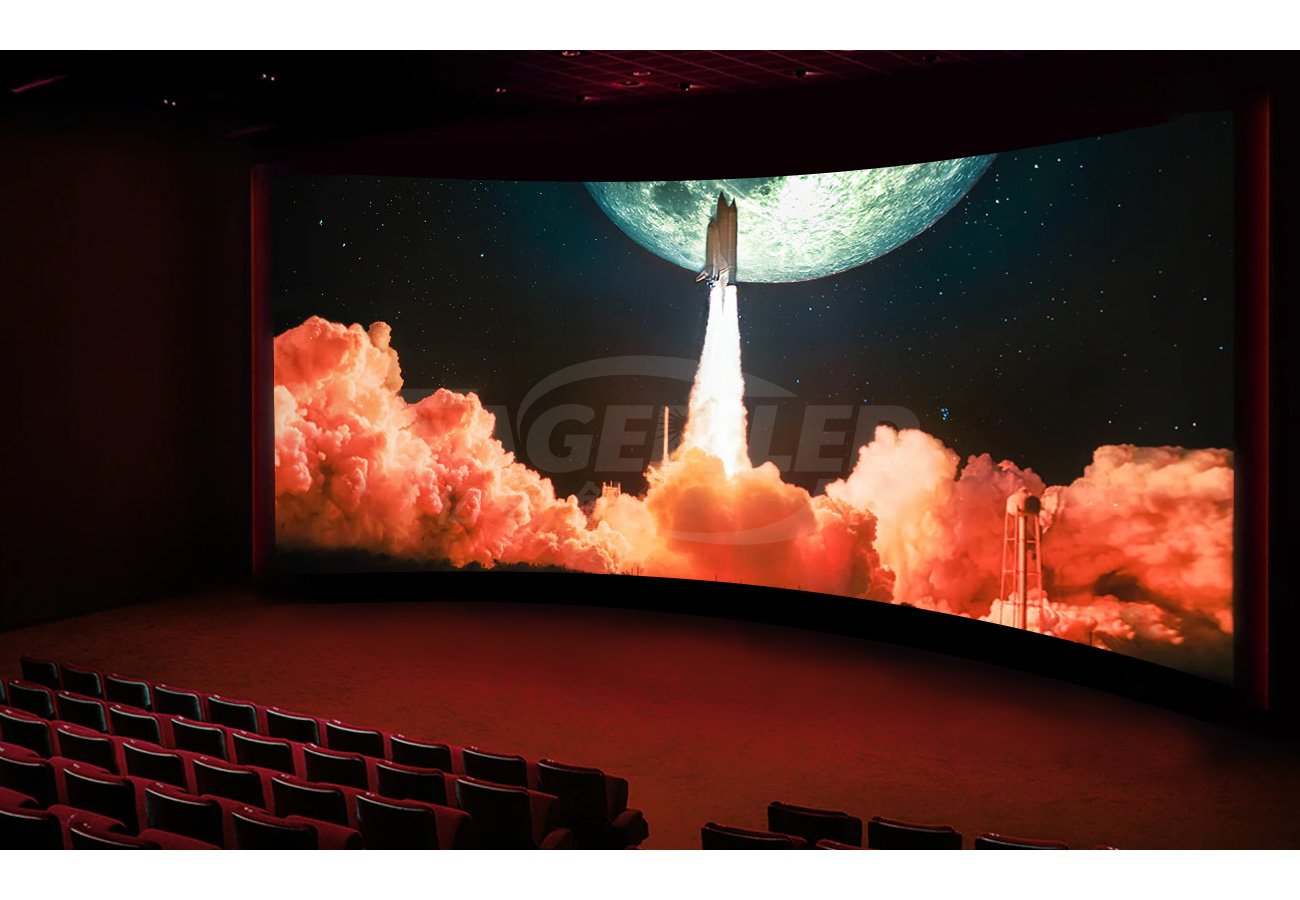
A flexible LED screen is made from soft LED modules on a bendable circuit board that follow a curved frame, so it can wrap columns, form waves or line a curved wall. Per square metre, the modules cost about the same as a flat LED wall at the same pitch, between 1% less and 21% more. The real extra cost of a curved screen is the custom support frame, the layout engineering and the installation, which are quoted to your drawing.
Flexible LED screen price per m² by pixel pitch
The table covers the EA-Flex indoor flexible display in all five module sizes (240 × 120, 320 × 160, 256 × 128, 250 × 250 and 300 × 168.75 mm). Finer pitches use GOB-coated modules, which protect the LEDs on a surface that people may touch.
| Pixel pitch | Price per m² | Price per sq ft | Typical viewing distance |
|---|---|---|---|
| P4–P5 | US$535–US$621 | US$50–US$58 | Signage and ceilings seen from 4 m (13 ft) or more |
| P2.3–P3.076 | US$622–US$793 | US$58–US$74 | Retail, hospitality and stage features from about 2.5–3 m (8–10 ft) |
| P1.8–P2 (GOB) | US$987–US$1,141 | US$92–US$106 | Lobbies and showrooms viewed from about 2 m (6.5 ft) |
| P1.5–P1.6 (GOB) | US$1,222–US$1,342 | US$114–US$125 | Close viewing and text, from about 1.5 m (5 ft) |
| P1.2–P1.25 (GOB) | US$1,630–US$2,214 | US$151–US$206 | Reception desks and counters viewed at arm’s length |
| P0.9 | US$6,108 | US$567 | Premium close-up displays |
Reference ex-factory prices from the EagerLED Aug 2026 price list, in USD, for the standard configuration; final pricing is subject to a formal quotation. They cover the display modules only: the curved support frame, controller and video processing, power distribution, freight, taxes and installation are not included.
The same pitch costs more in a smaller module. P2.5 costs US$679 per m² in 320 × 160 mm modules and US$758 in 240 × 120 mm modules, because more, smaller modules are needed to cover each square metre. Choose the small module only when the curve is tight enough to need it. The pixel pitch and viewing distance guide explains how to pick a pitch from the nearest viewer.
Flexible vs flat LED screen cost at the same pitch
It is easy to assume a flexible screen costs far more than a normal LED wall. The module prices say otherwise. Compared with the flat EA640F2 indoor cabinet, which uses the same 320 × 160 mm module size:
| Pitch | EA-Flex (flexible) per m² | EA640F2 (flat) per m² | Difference |
|---|---|---|---|
| P4 | US$579 | US$511 | +13% |
| P3.076 | US$622 | US$588 | +6% |
| P2.5 | US$679 | US$684 | −1% |
| P2 GOB | US$987 | US$830 | +19% |
| P1.86 GOB | US$1,045 | US$865 | +21% |
| P1.53 GOB | US$1,222 | US$1,096 | +11% |
| P1.25 GOB | US$1,630 | US$1,515 | +8% |
The flat wall arrives as cabinets that bolt into a standard grid. Flexible modules have no cabinet: they attach magnetically to a metal frame that has to be designed and built for each shape. A flat wall’s mounting is simple and repeatable, while a curved frame has to be engineered and fabricated for that one screen, so expect the installed difference to sit in structure and labour rather than in the LEDs. For a standard rectangle, the indoor LED screen price guide covers flat walls, and the LED screen price overview compares indoor, outdoor and rental cabinets.
Curved LED wall cost: a 5.76 m retail feature wall
Take a curved feature wall in a showroom or flagship store: 5.76 m (18.9 ft) along the curve and 1.92 m (6.3 ft) high, 11.06 m² (119 sq ft) in total. With 320 × 160 mm modules it is 18 modules across and 12 high, 216 modules in all.
| Pitch | Native canvas | EA-Flex curved wall | Same size flat EA640F2 wall |
|---|---|---|---|
| P3.076 | 1872 × 624 | US$6,879 | US$6,503 |
| P2.5 | 2304 × 768 | US$7,509 | US$7,564 |
| P1.86 GOB | 3096 × 1032 | US$11,557 | US$9,566 |
P2.5 is the value point for a wall that shoppers see from 2.5 m (8 ft) or more: it costs the same as the flat version and gives a 2304 × 768 canvas, wide enough for a panoramic brand film. Choose P1.86 GOB if people will walk right up to the wall or touch it.
Budget spare modules with the screen, because a curved surface is hard to patch later with a module from a different production batch. Holding 5% spares (11 modules) costs US$198 at P3.076, US$231 at P2.5 (US$21 per module) and US$440 at P1.86 GOB (US$40 per module), using the matching flexible modules from the flexible LED module range. At EA-Flex’s listed 100 W/m² average and 300 W/m² maximum, this wall draws about 1.1 kW on average and needs circuits for about 3.3 kW.
What is a flexible LED screen and how does it bend?
A flexible LED screen uses soft modules whose LEDs are mounted on a bendable printed circuit board with a soft mask, instead of a rigid board in a die-cast cabinet. Each module bends a little, and many modules side by side create the curve. EagerLED states a bending limit of up to 45° for EA-Flex modules and asks for the screen shape and module configuration to be confirmed before installation. It does not publish a minimum radius, so have the supplier approve your radius on a module layout drawing.
Three practical rules follow from that construction:
- Smaller modules follow tighter curves. A 240 × 120 mm module spans less of the arc than a 320 × 160 mm one, so it fits a small column better, at a higher price per m².
- The frame sets the shape, not the module. The modules take the shape of the steel or aluminium frame behind them. An accurate frame is what makes a curve smooth and seam-free.
- Bend once, then fix. Flexible modules are meant to be shaped onto a fixed frame, not rolled up and reshaped for every event. For curves that are rebuilt again and again, use curved rental cabinets.
Flexible LED display types: modules, rental cabinets and film
“Flexible LED display” covers three different products, and their prices are not comparable without knowing which one a quote describes.
| Type | Example | Price | Best for |
|---|---|---|---|
| Flexible LED modules on a fixed frame | EA-Flex, P0.9–P5 | US$535–US$6,108 per m² | Permanent columns, waves, curved walls, ceilings |
| Loose soft modules for integrators | Flexible indoor modules, 240 × 120 to 320 × 160 mm | US$10–US$168 per module | Integrators building their own frame; spares |
| Curved rental cabinets | EA500H7, 500 × 500 mm | US$285–US$395 per cabinet (US$1,140–US$1,580 per m²) | Touring stages and exhibitions with concave, convex or cylindrical walls |
| Flexible transparent LED film | EA-iFilm2, P4–P20 | US$762–US$2,985 per m² | Curved glass and shop windows |
EA500H7 cabinets combine flexible modules with a sliding mechanism that sets each cabinet’s curve, and they come in indoor (IP31, 750 cd/m²) and outdoor (IP65, 4,500–4,800 cd/m²) versions. A concave 4 × 2.5 m (13.1 × 8.2 ft) event wall of 40 cabinets costs US$11,400 at P2.97, US$12,640 at P2.6 GOB and US$15,800 at P1.95 GOB, and its cabinets weigh about 280 kg at 7 kg each. The LED sphere vs cylindrical display guide prices a full cylinder built from these cabinets.
EA-iFilm2 is a self-adhesive film, about 2 mm thick and 90–95% transparent, that can follow curved glass; the transparent LED film vs cabinet guide compares it with framed transparent screens.
Where flexible LED panels make sense
| Application | Shape | Suggested pitch |
|---|---|---|
| Column or pillar wrap in a mall, airport or lobby | Cylinder | P2.5–P3.076, P1.86 if people stand close |
| Curved reception or bar front | Convex arc | P1.53–P1.86 GOB |
| Retail feature wall or museum gallery | Concave arc or wave | P2–P2.5 |
| Ceiling or overhead ribbon | Wave or S-curve | P3.076–P4 |
| Stage set or concert backdrop for touring | Adjustable curve | EA500H7 rental cabinets |
| Curved shop window | Curved glass | EA-iFilm2 film |
Choose a flat wall instead when the surface is flat. Flexible modules cost about the same per m², but the custom frame and the more careful installation only pay off when the shape actually needs them.
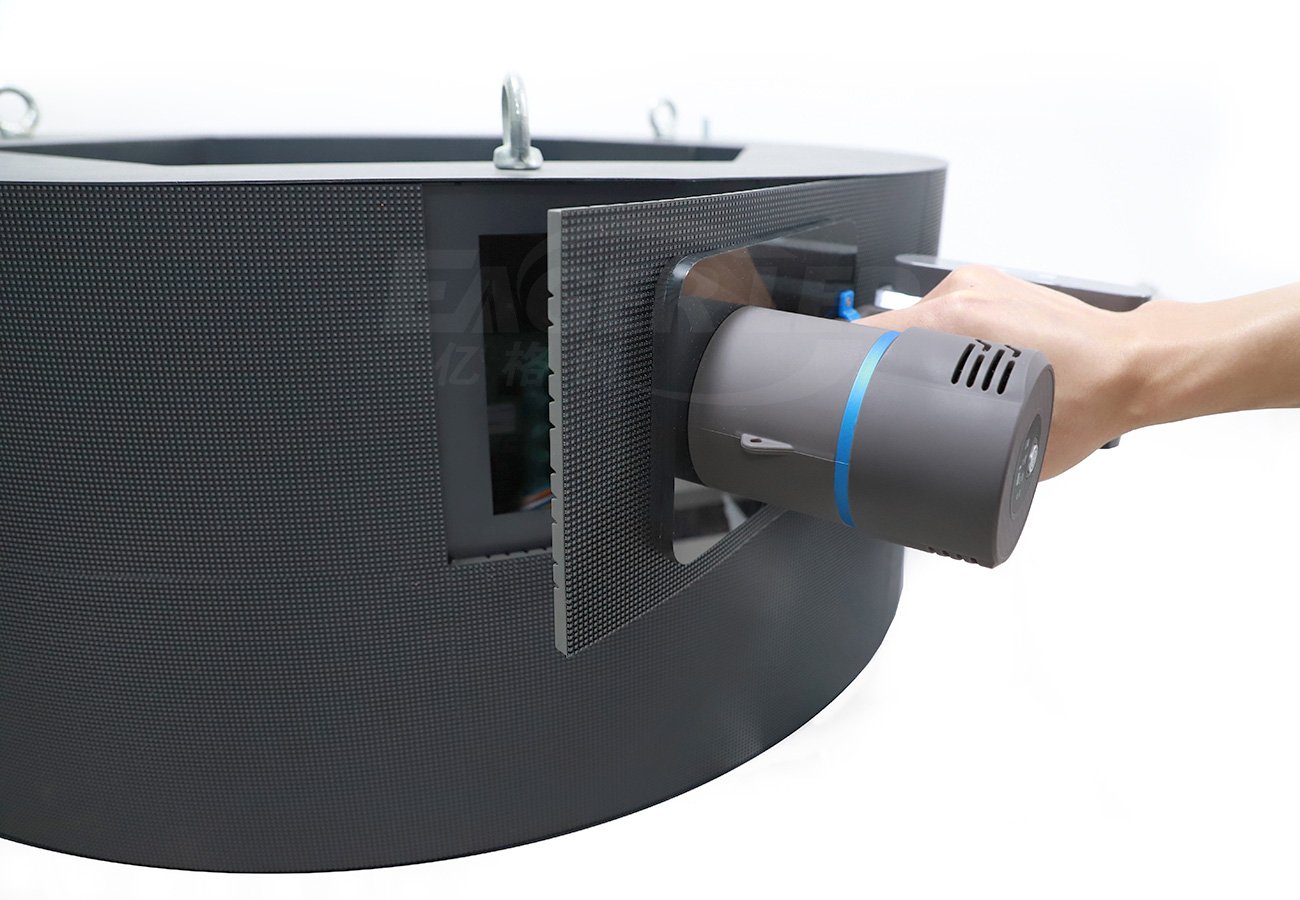
Installation: frame, magnets and front service
EA-Flex modules attach magnetically to a metal support frame, and technicians remove them from the front with dedicated tools, so no rear access space is needed. Plan these items together:
- Frame drawing. A plan and elevation with the curve radius, the start and end of every curve, and the module grid. Ask the supplier to mark where each module sits.
- Magnet contact. The frame needs flat steel strips or plates at the module’s magnet positions; a smooth surface gives an even screen face.
- Cable space. Leave room behind the modules for power supplies, receiving cards and cables. Curves leave less room inside the arc than a flat wall.
- Content mapping. Prepare video at the native canvas, such as 2304 × 768 for the P2.5 example, and check how text reads across the curve from the main viewing positions.
- First removal. Confirm that the first module can be lifted out once trim and adjoining finishes are installed.
The flexible module specifications list close pitches such as P1.53 and P1.56 with different pixel matrices and scan rates, so put the exact module size, pitch and model on the order and keep the same item on the spare-parts list. The hardware vs installed cost guide shows how frame, labour and commissioning add up on a real project.
Power, brightness and indoor limits
EA-Flex modules are rated at 600–800 cd/m² depending on the version, plenty for indoor spaces, with a 140° viewing angle, 14-bit grey scale and a refresh rate of at least 3,840 Hz, which helps avoid flicker on phone cameras. Power is listed at 100 W/m² average and 300 W/m² maximum, and the modules run on AC 100–240 V.
They are rated IP31, so they belong indoors. For an outdoor curve, use the outdoor EA500H7 versions (IP65, 4,500–4,800 cd/m²) or a curved cabinet design quoted for outdoor use; if an indoor screen faces a sunny window, plan ventilation, because heat builds up behind the glass. The flat EA640F2 used in the comparison above is likewise an IP31 indoor cabinet with magnetic front service.
What a flexible LED screen quote should include
Ask every supplier to price the same items so a cheap module price cannot hide a missing frame:
| Item | What to check |
|---|---|
| Display modules | Exact model, module size, pitch, quantity and price per m² |
| Spare modules | Quantity and the same batch as the screen |
| Support frame | Who designs, fabricates and installs it; drawings included |
| Control system | Sending and receiving cards, video processor, content player |
| Power | Power supplies, distribution and circuit sizes |
| Installation | Labour, access equipment, commissioning and colour calibration |
| Freight and taxes | Delivery destination and packing for curved parts |
Send your shape drawing, the nearest viewing distance and a sample of your content to request a quote, or compare all curved, spherical and shaped models in the flexible LED screen collection.
Frequently asked questions
How much does a flexible LED screen cost?
Indoor flexible LED screens cost about US$535–US$2,214 per m² (US$50–US$206 per sq ft) from P5 to P1.2, and US$6,108 per m² at P0.9. A 5.76 × 1.92 m curved P2.5 wall costs about US$7,509 for the modules.
Is a flexible LED screen more expensive than a normal LED wall?
Per square metre, only slightly. EA-Flex modules cost between 1% less and 21% more than a flat EA640F2 wall at the same pitch. The custom curved frame and the installation add most of the extra cost.
How much can a flexible LED screen bend?
EagerLED states a bending limit of up to 45° for each EA-Flex module. Smaller modules follow tighter curves. There is no universal minimum radius, so the supplier should approve your radius on a layout drawing.
Can a flexible LED screen be used outdoors?
EA-Flex modules are rated IP31 and are for indoor use. For outdoor curved screens, use outdoor curved rental cabinets such as EA500H7 (IP65, 4,500–4,800 cd/m², US$1,140–US$1,516 per m²).
Can you roll up a flexible LED screen?
Flexible modules are shaped once onto a fixed frame; they are not meant to be rolled up and reshaped for every event. For curves that change with each show, use rental cabinets with an adjustable curve such as EA500H7.
What is the difference between a flexible LED screen and LED film?
A flexible LED screen is a solid, opaque display made of soft modules on a frame. LED film such as EA-iFilm2 is a thin, 90–95% transparent layer stuck to glass, used on curved or flat windows. Film costs US$762–US$2,985 per m².
How much power does a flexible LED screen use?
EA-Flex lists 100 W/m² average and 300 W/m² maximum. An 11 m² (119 sq ft) curved wall uses about 1.1 kW on average and needs circuits for about 3.3 kW.
Which pixel pitch should I choose for a curved LED wall?
Use P2.5–P3.076 when viewers stand 2.5 m (8 ft) or more away, P1.86–P2 GOB from about 2 m, and P1.25–P1.56 GOB for counters and close-up viewing.
Check the details
Sources & references
Source pages can change. Access dates record when they were consulted.
- EA-Flex specifications Accessed 2 November 2026
- Flexible module specifications Accessed 2 November 2026
- EA500H7 specifications Accessed 2 November 2026
- EA-iFilm2 specifications Accessed 2 November 2026
- EA640F2 specifications Accessed 2 November 2026
Put these details into your project brief.
Tell EagerLED the application, destination and screen dimensions you have in mind.
Request a project quote