Quick answer
A programmable LED sign is an LED display whose text, pictures and video you change from a computer, a phone app or a USB stick, instead of swapping letters by hand. A small media player inside or behind the sign stores the messages and plays them on a schedule, so no computer has to stay connected.
Sources used: EagerLED outdoor LED signs guide; EA960R4 specifications; Asynchronous playback guide; 4G media player guide; LED controller capacity guide; EA1920OP2 specifications
For a full-color sign, the screen costs:
| Sign | Size | Pitch | Screen price, one face |
|---|---|---|---|
| Small message sign, EA960R4 | 1.92 × 0.96 m (6.3 × 3.1 ft) | P10–P4 | US$920–US$1,062 |
| Message strip, EA960R4 | 2.88 × 0.96 m (9.4 × 3.1 ft) | P10–P4 | US$1,380–US$1,593 |
| Business sign, EA960R4 | 2.88 × 1.92 m (9.4 × 6.3 ft) | P10–P4 | US$2,759–US$3,185 |
| Roadside sign, EA960R4 | 3.84 × 1.92 m (12.6 × 6.3 ft) | P10–P4 | US$3,679–US$4,247 |
| Large board, EA960R4 | 4.80 × 2.88 m (15.7 × 9.4 ft) | P10–P4 | US$6,898–US$7,963 |
| Sidewalk poster, EA1920OP2, double-sided | 0.64 × 1.92 m (2.1 × 6.3 ft) | P2.5–P1.86 | US$1,568–US$3,746 |
Reference ex-factory prices from the EagerLED Aug 2026 price list, in USD, for the standard configuration; final pricing is subject to a formal quotation. The cabinet prices exclude the media player, the pole or frame, power to the sign, permits, freight, duties and installation by a local sign contractor. A sign that faces traffic from both directions needs two faces.
What a programmable LED sign is
The name covers three kinds of product that look alike in search results but do different jobs:
| Type | What it shows | Typical use | Covered here |
|---|---|---|---|
| Text-only scrolling sign | One or more lines of red, amber or tri-color text | “Open” and offer signs in a shop window, queue numbers | Not priced; a separate, low-cost product class |
| Full-color outdoor message sign | Text, logos, photos, video, clock and temperature | Business, school, church and roadside signs | Yes, EA960R4 cabinets |
| Full-color LED poster | Portrait video and stills, often double-sided | Sidewalk, shop entrance, lobby, event entrance | Yes, EA1920OP2 |
A full-color sign is built from outdoor cabinets that hold the LED modules, power supplies and receiving cards. The controller or media player sends content to those receiving cards; it does not replace them, as EagerLED’s controller capacity guide explains. Because the sign is modular, you choose its size in steps of one cabinet rather than from a fixed catalogue of sign sizes.
EagerLED’s outdoor LED signs guide separates a storefront message board, a large outdoor sign and a roadside billboard because each one has a different viewing distance and a different mounting plan. Start from the location, the audience distance and the smallest message people must read, then pick the hardware.
Programmable LED sign prices by size
The table prices one face built from 960 × 960 mm EA960R4 outdoor cabinets at each common pitch:
| Size | Cabinets | P10 | P8 | P6.67 | P5 | P4 |
|---|---|---|---|---|---|---|
| 1.92 × 0.96 m (6.3 × 3.1 ft), 1.84 m² | 2 | US$920 | US$920 | US$997 | US$942 | US$1,062 |
| 2.88 × 0.96 m (9.4 × 3.1 ft), 2.76 m² | 3 | US$1,380 | US$1,380 | US$1,496 | US$1,413 | US$1,593 |
| 2.88 × 1.92 m (9.4 × 6.3 ft), 5.53 m² | 6 | US$2,759 | US$2,759 | US$2,992 | US$2,826 | US$3,185 |
| 3.84 × 1.92 m (12.6 × 6.3 ft), 7.37 m² | 8 | US$3,679 | US$3,679 | US$3,989 | US$3,768 | US$4,247 |
| 4.80 × 2.88 m (15.7 × 9.4 ft), 13.82 m² | 15 | US$6,898 | US$6,898 | US$7,479 | US$7,064 | US$7,963 |
The per-area prices behind the table are US$499 per m² (US$46 per sq ft) at P10 and P8, US$511 at P5, US$541 at P6.67 and US$576 at P4. Two points stand out. P8 costs the same as P10 in this cabinet, so P8 gives 56% more pixels for the same money. P5 costs less than P6.67 and has more than 1.7 times as many pixels, so it is the better value of the middle pitches.
The EA960R4 is a 960 × 960 mm cabinet weighing 23 kg, rated IP65, with a 140° viewing angle, a refresh rate of at least 3,840 Hz and brightness of 5,000–8,000 cd/m² depending on the version. Its product page is EA960R4. For other outdoor models and every pitch, see the outdoor LED screen price guide.
How to program an LED sign
There are two ways to drive a sign, and most programmable signs use the first:
- Asynchronous (stored) playback. You build a program on a computer or phone, send it to a media player at the sign, and the player keeps running it from its own memory. EagerLED’s asynchronous playback guide puts it plainly: the player runs stored content without a computer attached, but a computer or mobile device is still needed to prepare and publish that content.
- Synchronous (live) playback. A computer or video switcher feeds the sign through HDMI and the sign mirrors that source. This suits a live feed, such as a scoreboard or an event camera, but the source computer must stay switched on.
Some players can do both and switch between them. Decide which mode the sign should use day to day, who may switch it, and how staff restore the normal program after a restart.
The update route is a separate choice:
| Update method | How it works | Best for |
|---|---|---|
| USB stick | Copy the program file to a stick and plug it into the player | A single sign that changes once a month or less |
| Phone app over Wi-Fi | Connect the phone to the player’s own Wi-Fi hotspot and send the program | A shop owner standing in front of the sign |
| Wired network (Ethernet) | Publish from an office computer on the same network | A sign on the building, with a cable run to it |
| 4G or internet cloud | Publish from anywhere through a cloud platform and a mobile data link | Remote sites, several signs, or no network at the sign |
Check that the hardware you order supports the route you need. EagerLED’s 4G media player guide warns that a “4G” model name does not prove the cellular module is included; the module may be optional, and the order should say whether it is fitted. A phone connected to the player’s local hotspot also does not prove that a colleague elsewhere can publish over the internet, so test each route separately at handover.
The player must also have capacity for the sign. As a rough guide, horizontal pixels equal sign width in millimetres divided by the pitch. A 3.84 × 1.92 m P5 sign is 768 × 384 pixels, well within small media players, while large boards and fine pitches need a check against the player’s published pixel limit and output ports.
Text lines and characters by pixel pitch
Most programmable signs show text, so the useful question is how much text fits. The table assumes a common 16-pixel font about 9 pixels per character wide:
| Pitch | Height of a 16-pixel line | 16-pixel lines on a 0.96 m (3.1 ft) high sign | Characters per line, 2.88 m (9.4 ft) wide | Price per sq ft |
|---|---|---|---|---|
| P10 | 160 mm (6.3 in) | 6 | 32 | US$46 |
| P8 | 128 mm (5.0 in) | 7 | 40 | US$46 |
| P6.67 | 107 mm (4.2 in) | 9 | 48 | US$50 |
| P5 | 80 mm (3.1 in) | 12 | 64 | US$47 |
| P4 | 64 mm (2.5 in) | 15 | 80 | US$54 |
A coarse pitch is not a weaker sign: it simply draws each letter with fewer, larger pixels. For drivers, letter height matters more than pixel count. Lines of 32 pixels or more, two or three lines on a 0.96 m sign, read far better from a moving car than a screen filled with small text. A finer pitch earns its cost when people stand close, such as pedestrians at a shop front, or when the sign shows photos and video.
Choose pitch from the nearest realistic viewer and the smallest text you need to show, as the outdoor signs guide advises. A common rule of thumb gives 2–3 m of comfortable viewing per millimetre of pitch, so P10 suits viewers from about 20–30 m (66–98 ft) and P4 from about 8–12 m (26–39 ft). The pixel pitch and viewing distance guide explains the method.
Scrolling messages that people can read
Scrolling text is what most cheap programmable signs do, but it is often the wrong choice for a full-color outdoor sign:
- Hold, don’t scroll, for drivers. A driver glances at the sign for a second or two. A message that appears whole and holds still is read faster than text crawling across the screen.
- One idea per screen. Keep each message to a few words: an offer, a date, a phone number. Run a loop of four to six messages rather than one crowded screen.
- Check the local sign code first. Many towns limit how often a roadside electronic sign may change, require a minimum hold time, and ban scrolling, flashing or animation. Program the player to match the rule.
- Use scrolling where people stand still. Inside a shop, a queue or a waiting room, a scrolling line works well because readers have time.
- Schedule by time of day. Players can switch programs by time and date: breakfast offers in the morning, events in the evening, a holiday message on the day.
- Dim at night. Ask for automatic brightness control or a brightness schedule, so the sign is readable at noon and does not glare at night.
Daylight readability needs high brightness. For the trade-off between 4,500, 5,000 and 6,500 nits, see outdoor LED brightness: 4500 vs 5000 vs 6500 nits.
Storefront and sidewalk signs
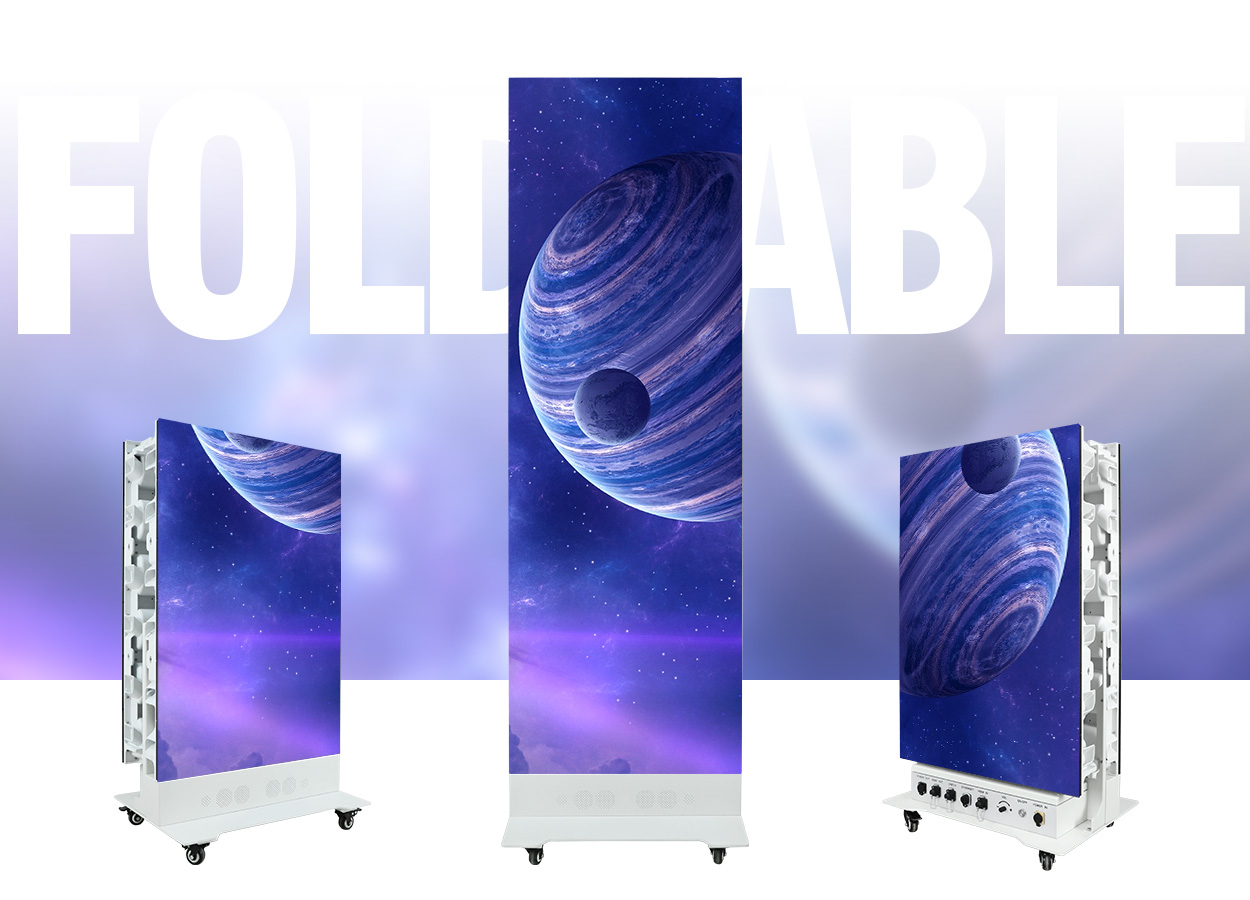
For a shop front, a café terrace or an event entrance, a programmable LED poster is simpler than a pole sign. The EA1920OP2 is a 640 × 1920 mm double-sided poster on four wheels, folding for transport and storage, with each side able to show its own content. Its front and rear are rated IP65, it runs at 4,000–5,000 cd/m² depending on pitch, and it weighs 58.2 kg.
| EA1920OP2 version | Resolution per side | Brightness | Price, double-sided set |
|---|---|---|---|
| P2.5 | 256 × 768 | 5,000 cd/m² | US$1,568 |
| P2 | 320 × 960 | 4,500 cd/m² | US$2,429 |
| P1.86 | 344 × 1032 | 4,000 cd/m² | US$3,746 |
Programming is local: the rear panel has USB 3.0, Ethernet and HDMI in and out, so content can be copied from a stick, published over the network or played live from a laptop, and built-in speakers carry sound. Several units can be locked side by side into a wider screen. Its product page is EA1920OP2; indoor posters and their prices are in the LED poster display price guide.
Power, weight and mounting
A programmable sign runs most of the day, so power is a running cost, not just a circuit size. EA960R4 at P6.67 lists 650 W/m² maximum and 220 W/m² average:
| Sign | Area | Maximum power | Current at maximum | Average power | Energy, 18 h a day |
|---|---|---|---|---|---|
| 2.88 × 0.96 m | 2.76 m² | 1.80 kW | 15.0 A at 120 V, 7.8 A at 230 V | 0.61 kW | about 4,000 kWh a year, about US$600 at US$0.15/kWh |
| 3.84 × 1.92 m | 7.37 m² | 4.79 kW | 39.9 A at 120 V, 20.8 A at 230 V | 1.62 kW | about 10,660 kWh a year, about US$1,600 at US$0.15/kWh |
Size the circuit from the maximum figure and leave the design to a licensed electrician. Night dimming and dark backgrounds bring real consumption below the average figure. LED power: average vs maximum explains why the two numbers differ.
At 23 kg a cabinet, a 2.88 × 0.96 m sign weighs 69 kg (152 lb) and a 3.84 × 1.92 m sign 184 kg (406 lb), before the frame. The pole or monument must be designed for local wind loads by a structural engineer, and the sign usually needs a permit. The outdoor LED pylon and monument sign planning guide covers structures; the outdoor digital signage guide compares sign types for businesses; and the outdoor church LED message sign and fuel station LED price sign guides cover two common programmable signs in detail.
Programmable LED sign quote checklist
Ask the supplier to itemise:
- Cabinet model, pitch, cabinet count, sign size and resolution.
- The media player or control card, its pixel limit, and which modes it supports (stored, live or both).
- Every update route you plan to use (USB, Wi-Fi, Ethernet, 4G), and whether a 4G module and antenna are fitted or optional.
- The content software, whether it runs on a phone, a computer or a cloud account, and who holds the login.
- Automatic dimming or a brightness schedule.
- Maximum and average power, the supply voltage and the circuit size.
- Spare modules, power supplies and receiving cards.
- Freight, duties and the warranty.
Get the frame or pole, foundations, electrical work, permit and installation quoted by a local sign contractor. EagerLED’s outdoor signs guide recommends asking for a drawing and a site-specific specification before ordering. At handover, publish a test message by each update route, restart the player and confirm the right program comes back, and check legibility from the nearest and farthest viewing points by day and by night.
Frequently asked questions
How much does a programmable LED sign cost?
For a full-color outdoor sign, about US$920–US$1,062 for a 1.92 × 0.96 m face, US$1,380–US$1,593 for a 2.88 × 0.96 m message strip, US$2,759–US$4,247 for a business sign up to 3.84 × 1.92 m and US$6,898–US$7,963 for a 4.80 × 2.88 m board, for the screen alone. The pole, power, permit and installation are added.
How do you program an LED sign?
Build the program (text, images, video, schedule) in the player’s software on a computer or phone, then send it to the sign’s media player by USB stick, Wi-Fi, a wired network or a 4G cloud link. The player stores the program and plays it without a computer attached.
Can I change an LED sign from my phone?
Yes, if the media player has Wi-Fi or a 4G/cloud connection. Over Wi-Fi you connect to the player’s own hotspot near the sign; for updates from anywhere, the player needs a 4G module or an internet connection and a cloud account.
Does a computer have to stay connected to the sign?
No. In asynchronous mode the player plays the stored program on its own, and should bring it back after a restart; test that at handover. A computer is needed only to prepare and publish new content, or to feed live video in synchronous mode.
What is the difference between a scrolling LED sign and a full-color LED sign?
A scrolling sign shows lines of text in one or a few colors and is mainly a low-cost window or counter sign. A full-color sign is built from LED cabinets and shows text, logos, photos and video at a size and brightness made for outdoor viewing.
What pixel pitch should a business sign use?
P8–P10 for passing traffic 20 m (66 ft) or more away, P5–P6.67 for a car park or slow street, and P4 or finer, or an LED poster, for pedestrians within a few metres.
How much power does an outdoor programmable LED sign use?
A 2.88 × 0.96 m full-color sign draws up to 1.8 kW and averages about 0.6 kW, which comes to about 4,000 kWh a year over 18 hours a day before night dimming.
Check the details
Sources & references
Source pages can change. Access dates record when they were consulted.
- EagerLED outdoor LED signs guide Accessed 16 November 2026
- EA960R4 specifications Accessed 16 November 2026
- Asynchronous playback guide Accessed 16 November 2026
- 4G media player guide Accessed 16 November 2026
- LED controller capacity guide Accessed 16 November 2026
- EA1920OP2 specifications Accessed 16 November 2026
Put these details into your project brief.
Tell EagerLED the application, destination and screen dimensions you have in mind.
Request a project quote