Quick answer
An LED poster display costs US$1,275–US$2,313 per unit for a standard indoor 640 × 1920 mm (2.1 × 6.3 ft) foldable poster, depending on pixel pitch (P2.5 down to P1.25) and module type (GOB or COB). An outdoor IP65 poster of the same size costs US$1,568–US$3,746, and a four-sided indoor 3D poster costs US$5,827–US$9,628.
Sources used: EA1920iP5 specifications; EA1920OP2 specifications; EA3DiP1 specifications; EA640F2 specifications
Each foldable poster price is for a complete free-standing unit: both display faces, the wheeled stand, built-in speakers and the playback connections. That puts an indoor poster at about US$1,038–US$1,882 per m² (US$96–US$175 per sq ft) of display area. This is more per square metre than a plain LED cabinet wall, because the stand and player are part of the price.
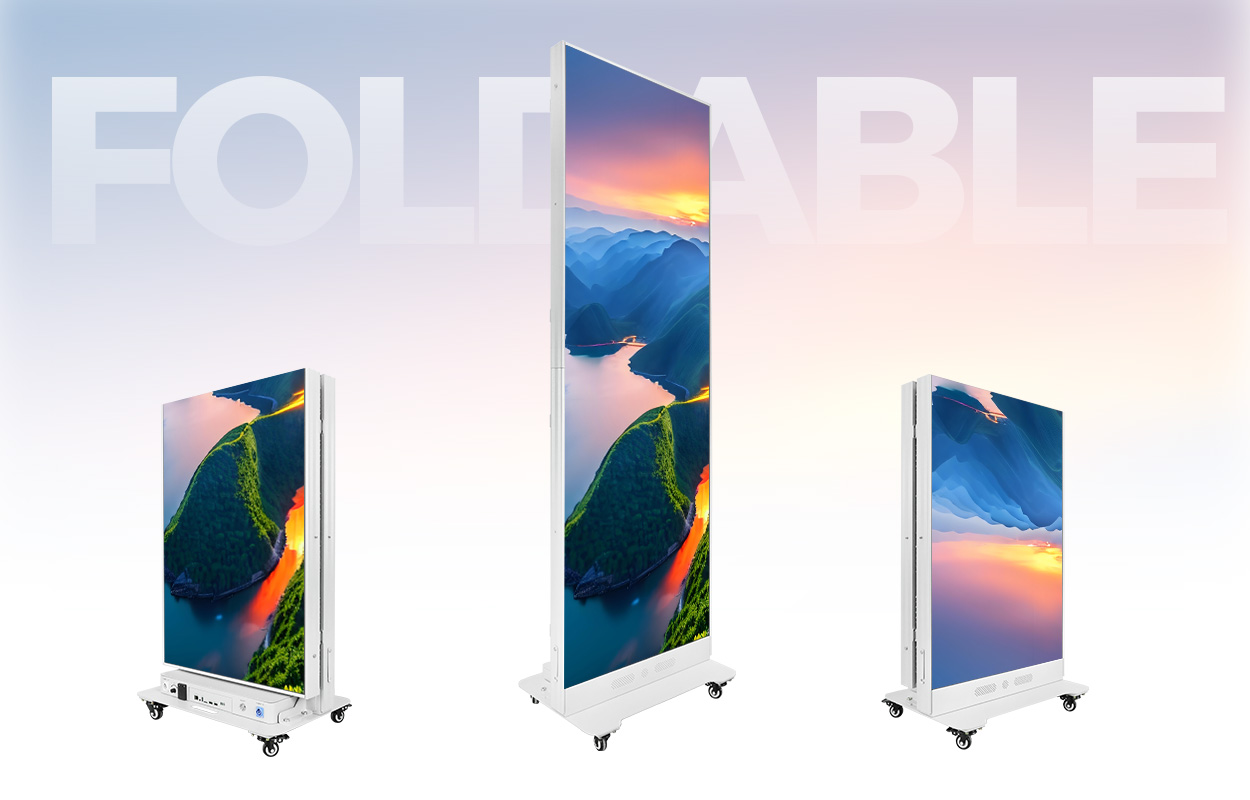
LED poster display price at a glance
All three products below use 320 × 160 mm modules. The two foldable posters show a 640 × 1920 mm image on each of their two faces, so the per-m² figures are for one face (1.23 m², 13.2 sq ft).
| Model | Type | Pixel pitch | Price per unit | Per m² | Per sq ft |
|---|---|---|---|---|---|
| EA1920iP5 | Indoor foldable, GOB | P2.5 | US$1,275 | US$1,038 | US$96 |
| EA1920iP5 | Indoor foldable, GOB | P2 | US$1,371 | US$1,116 | US$104 |
| EA1920iP5 | Indoor foldable, GOB | P1.86 | US$1,414 | US$1,151 | US$107 |
| EA1920iP5 | Indoor foldable, GOB | P1.53 | US$1,703 | US$1,386 | US$129 |
| EA1920iP5 | Indoor foldable, GOB | P1.25 | US$2,227 | US$1,812 | US$168 |
| EA1920iP5 | Indoor foldable, COB | P1.86 | US$1,424 | US$1,159 | US$108 |
| EA1920iP5 | Indoor foldable, COB | P1.53 | US$1,861 | US$1,514 | US$141 |
| EA1920iP5 | Indoor foldable, COB | P1.25 | US$2,313 | US$1,882 | US$175 |
| EA1920OP2 | Outdoor foldable, IP65 | P2.5 | US$1,568 | US$1,276 | US$119 |
| EA1920OP2 | Outdoor foldable, IP65 | P2 | US$2,429 | US$1,977 | US$184 |
| EA1920OP2 | Outdoor foldable, IP65 | P1.86 | US$3,746 | US$3,049 | US$283 |
| EA3DiP1 | Indoor four-sided 3D | P1.86 | US$5,827 | US$1,186 | US$110 |
| EA3DiP1 | Indoor four-sided 3D | P1.56 | US$7,080 | US$1,440 | US$134 |
| EA3DiP1 | Indoor four-sided 3D | P1.25 | US$9,628 | US$1,959 | US$182 |
Reference ex-factory prices from the EagerLED Aug 2026 price list, in USD, for the standard configuration; final pricing is subject to a formal quotation. Freight, import duty, local taxes and any flight case or software service not listed in the quotation are extra.
The EA3DiP1 per-m² figures use its total display area of 2.56 × 1.92 m (4.9 m²), which wraps around four faces.
For a market check, a European dealer, Kimex, lists slightly smaller 1,925 × 540 mm GOB posters with a flight case at €5,290 (P2.5) and €5,830 (P1.87), without saying whether VAT is included. Dealer prices include stock, local support and the dealer’s margin, so expect a retail quote to land well above a factory list price.
What an LED poster display is
An LED poster display, also sold as a poster LED screen, digital LED standee or LED totem, is a slim, self-standing LED screen in the shape of a printed poster. Most are about 640 mm wide and 1,920 mm tall (2.1 × 6.3 ft), stand on a wheeled base and play content from a built-in player. They replace paper posters and roll-up banners in shop entrances, hotel lobbies, malls, exhibitions and event venues.
Unlike an LCD standee, an LED poster has no glass panel. It is built from small LED modules, so several units can be locked side by side into one wider screen. It is also bright: 600–800 cd/m² for the indoor models in this guide and 5,000 cd/m² for the outdoor version, which can stand in daylight. The LED vs LCD video wall comparison covers the trade-offs in more detail.
Indoor foldable LED poster price (EA1920iP5)
The EA1920iP5 is an indoor, double-sided poster that folds in half at the middle hinge. Folding reduces its storage volume by up to 50%, and one person can fold it and pack it into its flight case. It weighs 55 kg (121 lb), rolls on four casters and services from the front, so it can stand close to a wall.
Each face can play its own content, and it connects over USB 3.0, HDMI, Ethernet, Wi-Fi or a SIM card slot, with cloud publishing from a phone or laptop. Brightness is 600–800 cd/m², refresh rate at least 3,840 Hz, and it is rated IP31 for indoor use.
Screen resolution per face depends on the pitch:
| Pitch | Resolution per face | Price |
|---|---|---|
| P2.5 | 256 × 768 pixels | US$1,275 |
| P2 | 320 × 960 pixels | US$1,371 |
| P1.86 | 344 × 1,032 pixels | US$1,414–US$1,424 |
| P1.53 | 416 × 1,248 pixels | US$1,703–US$1,861 |
| P1.25 | 512 × 1,536 pixels | US$2,227–US$2,313 |
Even P1.25 shows fewer pixels than a Full HD (1080 × 1920) portrait LCD of similar size. Design content for the poster’s actual resolution: large type, bold images and short video loops work; small print does not.
GOB or COB modules
Every EA1920iP5 pitch comes with GOB modules, which coat standard SMD LEDs with a protective glue layer. P1.25, P1.53 and P1.86 also come with flip-chip COB modules. COB costs between US$10 (P1.86) and US$158 (P1.53) more per unit.
Both protect the LEDs against knocks from trolleys, bags and visitors, which matters for a screen at hand height in a public space. The GOB vs SMD comparison explains how the two coatings differ.
Outdoor LED poster price (EA1920OP2)
The EA1920OP2 is the outdoor version: the same 640 × 1920 mm double-sided folding format, but 5,000 cd/m² bright and rated IP65 front and rear, so it can stand in direct sun and rain at an entrance or event gate. It weighs 58.2 kg (128 lb), runs on four wheels and services from a quick-release rear cover. The rear panel has HDMI in/out, USB 3.0, Ethernet and volume control, and it has built-in speakers.
Prices rise steeply as the pitch gets finer:
- P2.5 costs US$1,568, only US$293 more than the indoor P2.5.
- P2 costs US$2,429.
- P1.86 costs US$3,746, because it uses MIP (micro LED in package) modules instead of standard SMD.
For most outdoor posters viewed from the pavement, P2.5 is the value choice. The mobile LED signage guide covers transporting and powering wheeled posters at events.
3D four-sided LED poster price (EA3DiP1)
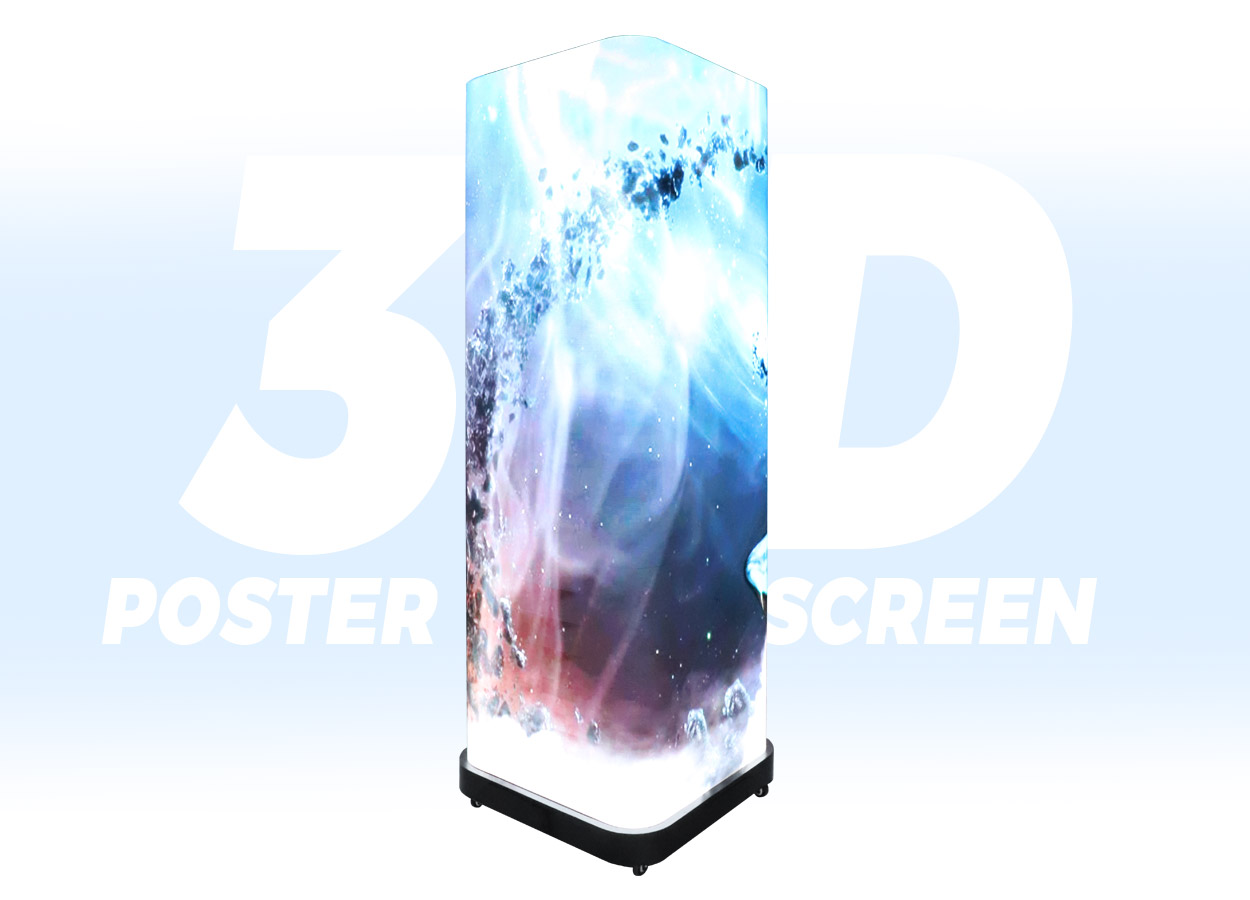
The EA3DiP1 is a column, not a flat poster. It measures 680 × 680 × 1,920 mm, has a screen on all four sides, and uses flexible modules at the corners so the image wraps around without a visible edge. With content prepared in the right perspective, it gives a naked-eye 3D effect.
It weighs 125 kg (276 lb), is for indoor use only and costs US$5,827 (P1.86), US$7,080 (P1.56) or US$9,628 (P1.25). Each face can take its own signal, or all four can play as one. Spare modules cost US$46–US$81 each.
The naked-eye 3D LED billboard guide explains how 3D content is produced and what it adds to the budget.
Which pixel pitch for a poster screen
A poster is usually seen from closer than a wall-mounted screen, so pitch matters more. Two common conventions help:
- Minimum distance: about 1 m per mm of pitch. At this distance the pixel grid is still visible.
- Comfortable distance: about 2–3 m per mm of pitch. Most viewers accept the image for text and video from here.
| Pitch | Minimum distance | Comfortable distance | Typical use |
|---|---|---|---|
| P2.5 | 2.5 m (8 ft) | 5–7.5 m (16–25 ft) | Mall concourses, outdoor entrances, event gates |
| P2 | 2 m (6.5 ft) | 4–6 m (13–20 ft) | Shop windows, lobbies |
| P1.86 | 1.9 m (6 ft) | 3.7–5.6 m (12–18 ft) | Retail floors, hotel receptions |
| P1.53–P1.56 | 1.5 m (5 ft) | 3–4.7 m (10–15 ft) | Showrooms, exhibition stands |
| P1.25 | 1.25 m (4 ft) | 2.5–3.75 m (8–12 ft) | Boutiques and counters seen at arm’s length |
The jump from P1.86 to P1.25 adds US$813–US$889 per indoor unit. Pay it only when people will stand within about 2 m (6.5 ft) of the screen. The pixel pitch and viewing distance guide explains both conventions.
Splicing posters vs building a small LED wall
LED posters can be locked side by side. Three EA1920iP5 units make a 1.92 × 1.92 m (6.3 × 6.3 ft) screen. The same area can also be built from twelve EA640F2 indoor cabinets (640 × 480 mm each) on a fixed structure. Both use 320 × 160 mm modules at the same pitches, so the resolution is identical.
| Pitch | 3 × EA1920iP5 posters | EA640F2 wall, 3.69 m² | Poster premium |
|---|---|---|---|
| P2.5 | US$3,825 | US$2,522 | +52% |
| P2 (GOB) | US$4,113 | US$3,060 | +34% |
| P1.86 (GOB) | US$4,242 | US$3,189 | +33% |
The comparison has two sides:
- The wall’s price is screen only. The wall still needs a mounting frame or stand, a controller or media player and installation, and these often close much of the gap.
- The posters come complete. Each one already has its stand, casters, player and speakers, and works alone on the day it arrives. After an event, the posters can split up again: one at the entrance, one by the lift, one in storage.
Choose posters when the screen will move or be reconfigured. Choose a fixed cabinet wall when it will stay in one place for years or must grow beyond a few metres. The indoor LED screen price guide prices larger fixed walls.
Running costs: power and spare modules
An LED poster draws a lot less than its peak rating, because the average image is never full white:
- EA1920iP5 (indoor): maximum 360–400 W, average 120–135 W per unit.
- EA1920OP2 (outdoor): maximum 750–850 W, average 250–285 W, because outdoor brightness needs more current.
On 12 hours a day, every day:
- An indoor poster uses about 530–590 kWh a year, about US$79–US$89 at an assumed US$0.15 per kWh.
- An outdoor poster uses about 1,100–1,250 kWh a year, about US$164–US$187 at the same rate.
Both run on standard AC 100–240 V, 50–60 Hz power, so one ordinary outlet is enough for one poster.
Keep one or two spare modules from the same production batch. A replacement module from a later batch may differ slightly in colour. All posters in this guide use 320 × 160 mm modules, but a spare only fits a poster of the same pitch and module type, so standardise on one model if you run a fleet.
What the LED poster price does not include
A poster quote is simple compared with an LED wall, but check these lines before you compare suppliers:
- Freight and import costs. Each 55–58 kg poster ships in a flight case or crate. For one or two units, air freight can cost a large share of the screen price, so ask for both sea and air quotes.
- Flight case. Ask whether it is included or quoted separately.
- Software and cloud service. Confirm whether cloud publishing needs an account, a licence or a SIM data plan.
- Spare modules and power supply. Order these with the posters.
- Warranty terms and response time. Get these in writing.
The LED screen price guide explains how list prices turn into a project budget for other LED products.
Frequently asked questions
How much does an LED poster display cost?
A standard 640 × 1920 mm indoor LED poster costs US$1,275–US$2,313 per unit from P2.5 to P1.25. An outdoor IP65 poster costs US$1,568–US$3,746, and a four-sided 3D poster US$5,827–US$9,628. These are 2026 ex-factory list prices. Freight, duty and local taxes come on top, and dealer retail prices are higher.
What does foldable mean on an LED poster display?
A foldable LED display hinges in the middle, so the top half folds down onto the bottom half. This cuts storage volume by up to half and lets one person pack the poster into its flight case. It suits rental, events and retailers who move screens between sites.
Can an LED poster be used outdoors?
Only an outdoor model. The EA1920OP2 is rated IP65 on both faces with 5,000 cd/m² brightness, enough for direct sun and rain. Indoor posters such as the EA1920iP5 are IP31 at 600–800 cd/m². They are not weatherproof and are too dim for daylight.
Can several LED posters be joined into one screen?
Yes. The posters lock side by side, so three units make a 1.92 × 1.92 m (6.3 × 6.3 ft) screen. At P2.5 that costs US$3,825 with the indoor model, against about US$2,522 for an equal fixed cabinet wall before its frame, controller and installation.
How much electricity does an LED poster use?
An indoor 640 × 1920 mm poster averages 120–135 W and peaks at 360–400 W. Over 12 hours a day that is about 530–590 kWh a year. An outdoor poster averages 250–285 W, roughly twice as much.
Which pixel pitch is best for an LED poster?
Choose by the closest viewer. P2.5 suits viewers from about 5 m (16 ft), P1.86 from about 4 m (13 ft), and P1.25 from 2.5 m (8 ft) or closer. Most retail entrances work well with P1.86 to P2.5. P1.25 costs about US$800–US$900 more per unit than P1.86 and only pays off at counters and in small boutiques.
Is an LED poster better than an LCD digital standee?
An LED poster is brighter, can be joined with others into a larger screen and has no glass to break. An LCD standee of the same size shows a sharper image at a closer distance. Choose LED for bright spaces, outdoor use and screens that may be combined; choose LCD for close-up viewing in dim interiors.
Check the details
Sources & references
Source pages can change. Access dates record when they were consulted.
- EA1920iP5 specifications Accessed 2 November 2026
- EA1920OP2 specifications Accessed 2 November 2026
- EA3DiP1 specifications Accessed 2 November 2026
- EA640F2 specifications Accessed 2 November 2026
- Kimex dealer LED poster listingsAccessed 2 November 2026
Put these details into your project brief.
Tell EagerLED the application, destination and screen dimensions you have in mind.
Request a project quote