Quick answer
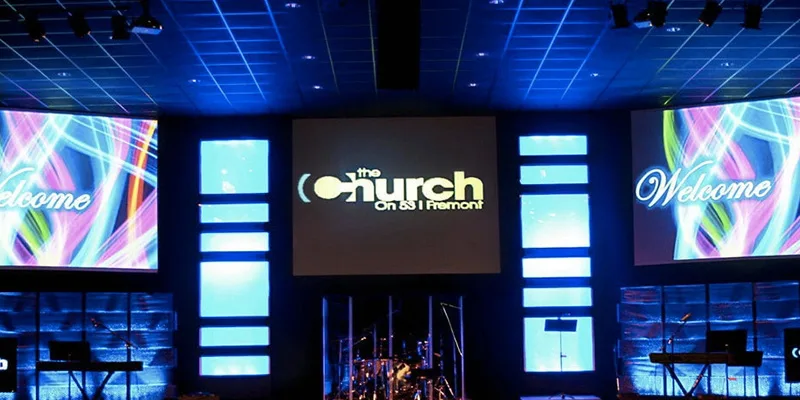
Choose an LED wall when the sanctuary has daylight or stage lighting, when services are filmed or streamed, or when the screen must be large and sharp from every seat: LED emits its own light, needs no projection surface and keeps its contrast in a lit room. A projector can still suit a darkened room with an existing screen and a tight first budget. For scale, a 5.12 × 2.40 m (16.8 × 7.9 ft) LED lyrics wall costs about US$7,225–US$12,423 for the screen at P3.076–P2.
Sources used: Church LED Display Guide &; Conference LED Screen Guide: 2026; EA250WH5 specs; EA600COB3 specs
Make the decision from a room survey: light levels during services, seating distances, ceiling height, camera use and where people stand on stage.
Church LED wall vs projector at a glance
| Factor | LED wall | Projector |
|---|---|---|
| Lit room or daylight | Stays bright and high-contrast | Washes out unless the room is darkened |
| Image surface | None needed; the wall is the image | Needs a screen, a throw path and alignment |
| Shadows on stage | None | Front projection casts shadows on anyone in the beam |
| Size and shape | Any size in whole cabinets, including very wide | Limited by lens, throw distance and brightness |
| Camera and streaming | Clean image at the right settings | Often looks dim or washed out on camera |
| Upfront cost | Higher | Lower |
| Running and upkeep | Power, spare modules, occasional calibration | Lamp or light-source replacement, filters, realignment |
EagerLED’s church display guide describes an LED wall as a modular direct-view screen for lyrics, scripture, sermon graphics, live video and stage backgrounds that stays visible in ambient light and needs no projection surface. Its conference screen guide notes that projected image quality depends on projector resolution, lens, throw distance, screen surface, alignment and ambient-light control.
What a church LED wall costs
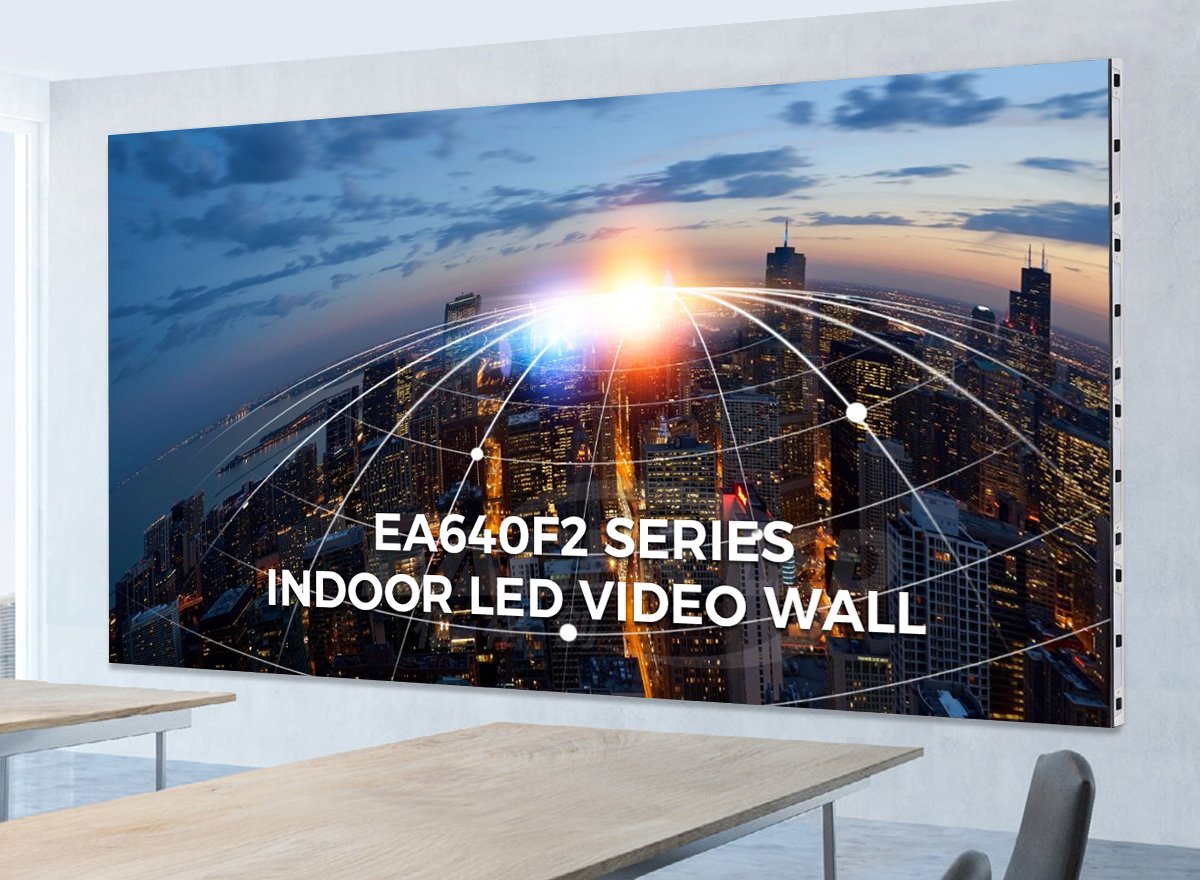
Lyrics and sermon slides usually suit a wide wall above the stage. Built from 640 × 480 mm EA640F2 or EA640H1 cabinets, 8 across and 5 high, a 5.12 × 2.40 m wall (about 223 in diagonal) covers 12.288 m² (132.3 sq ft):
| Configuration | Price per m² | Screen price | Resolution |
|---|---|---|---|
| EA640F2 P3.076 | US$588 (US$55 per sq ft) | US$7,225 | 1664 × 780 |
| EA640F2 P2.5 | US$684 (US$64 per sq ft) | US$8,405 | 2048 × 960 |
| EA640F2 P1.86 GOB | US$865 (US$80 per sq ft) | US$10,629 | 2752 × 1290 |
| EA640H1 P2 GOB | US$1,011 (US$94 per sq ft) | US$12,423 | 2560 × 1200 |
Reference ex-factory prices from the EagerLED Aug 2026 price list, in USD, for the standard configuration; final pricing is subject to a formal quotation. They exclude video processing beyond the standard receiving cards, the mounting structure, freight, taxes, installation and training. The church LED wall cost guide prices chapel, sanctuary and large-sanctuary walls, and the indoor LED screen price guide lists every indoor pitch.
The wall averages about 1.2 kW at P2.5 (100 W/m² on EA640F2) and needs about 3.7 kW at maximum. Used ten hours a week, it consumes roughly 12 kWh a week, or about 640 kWh a year.
When a projector still makes sense
Projection fits when the room can be darkened for the parts of the service that use the screen, when an existing screen and throw path are already in place, and when the first budget is tight. It also suits temporary venues such as a school hall on Sunday mornings. Before choosing it, check that the throw path is clear of the stage, that nobody will walk through the beam, and that the projector is bright enough for the room’s lighting at the screen size you need.
Plan the running costs of both: light-source replacement and filter cleaning for projection; spare modules, occasional calibration and electricity for LED. Compare total ownership over the same number of years, using written quotes.
Lyrics, live camera and the content workflow
A church screen shows lyrics, scripture, sermon slides, announcements and live camera feeds. Use large type, short lines and strong contrast so people at the back can follow, and coordinate visuals with lighting and audio cues. An LED wall can bring lyrics, announcements, slides and live feeds into one workflow; confirm compatibility with the church’s presentation software, switcher, cameras and signal format during design, and prepare templates for traditional worship, youth services, multilingual gatherings and special events.
For filmed or streamed services, refresh rate and greyscale matter. EagerLED documents at least 3,840 Hz refresh on EA250WH5 and EA600COB3, and describes the COB surface as producing less glare and fewer moiré artefacts on camera. Run a camera test with your cameras, shutter speed and brightness before ordering; the LED video wall moiré camera test lists what to check.
Viewing distance and pitch: start with the closest worshipper
Pitch sets how fine the image looks at a given distance. Start with the closest regular seat and the smallest lyric, scripture or caption text that must be readable, then use the pixel pitch and viewing distance guide. A common rule of thumb allows 2–3 m of comfortable viewing per millimetre of pitch, so P2.5 suits a front row about 5–7.5 m from the screen and P3.076 about 6–9 m.
EagerLED places EA250WH5 P1.25–P1.95 GOB in rooms watched from about 2 m and P2.5–P3.91 from about 3 m. EA600COB3 offers P0.62 to P1.87 in 16:9 cabinets for rooms where viewers sit very close, at US$1,366 per m² for P1.87. Side seats and camera positions also count: test from there, not only from the centre aisle.
Mounting, service and room constraints
EA250WH5 is a 30 mm deep indoor wall with front service and six cabinet sizes from 500 × 250 mm to 1000 × 500 mm, all on a 250 × 250 mm module. Modules, power supplies and control parts are reached from the front with a suction tool, so no aisle is needed behind the wall, and right-angle and column layouts are possible. EA600COB3 cabinets are 600 × 337.5 mm, 30 mm deep and 4.1 kg; modules release from the front and a cable-free HUB connection lets a module be swapped without disturbing its neighbours.
For a projector, the equivalent questions are where it hangs, how the light path crosses the stage, and how the screen is lowered or fixed. For either technology, confirm viewing distances, room lighting, structure, camera use, maintenance access and budget, and ask for the installed depth, mounting method, ventilation clearance and service route for the exact position.
Quotation and ownership: compare line by line
Compare total ownership with project-specific quotes rather than percentages. For LED, include the display, processor, cabling, control, mounting, installation, calibration, power, cleaning, spares, warranty and service labour. For projection, include the projector, lens, screen surface, mount, light-source replacement, filters, alignment and the cost of controlling room light (blinds or lighting changes). Put both on the same rows with how to compare LED screen quotes.
EagerLED quotes each indoor wall per project: EA250WH5 depends on pitch, wall size, cabinet quantity, control system, spares and shipping; EA600COB3 also on mounting structure. Ask for typical and maximum power for the chosen model and have the electrical design checked for the complete system.
A practical decision sequence for church AV teams
- Survey the room: wall size, closest, farthest and side seats, light levels during services, power, signal routes, ventilation, structure and service access.
- Decide the technology: LED where lyrics and video must stay visible in light or on camera; projection where the room can be darkened and budget is the main limit.
- For LED, shortlist cabinets by depth, pitch, viewing angle, camera performance and service access.
- Test real lyrics and a camera feed on a sample at the planned brightness.
- Compare quotes on the same lines and include running costs over several years.
Church scenarios and what to confirm first
| Scenario | Better fit | Confirm first |
|---|---|---|
| Bright sanctuary with windows | LED wall | Brightness setting for daylight and for the camera |
| Dark room with an existing screen | Projector | Room darkening, screen surface, throw path |
| Livestreamed services | LED wall | Camera test with your cameras and shutter |
| Shallow wall, no rear access | Front-service LED | Installed depth and front service route |
| Temporary venue on Sundays | Projector or rental LED | Setup time, storage and transport |
| Lobby welcome and wayfinding | Small LED screen or poster | Content updates and placement |
Frequently asked questions
Is an LED wall better than a projector for a church?
For bright rooms, filmed services and large screens, yes: it stays bright and sharp without darkening the room. A projector can be enough in a dark room with a tight budget.
How much does a church LED wall cost compared with a projector?
The LED screen for a 5.12 × 2.40 m lyrics wall costs about US$7,225–US$12,423 depending on pitch; a projector system usually costs less upfront. Compare both over several years, including screens, light sources, power and service.
What pitch does a church LED wall need?
P2.5 for front rows about 5–7.5 m away, P3.076 for larger rooms, and P1.86–P2 when the front row is closer or close-up cameras film the wall.
Does an LED wall work on livestreams?
Yes, at the right settings. Choose a wall with at least 3,840 Hz refresh and test it with your cameras and shutter speed before ordering.
How much power does a church LED wall use?
A 12.3 m² P2.5 wall averages about 1.2 kW, roughly 12 kWh for ten hours of use a week.
Send your room survey, seating plan and service schedule to request a quote.
Check the details
Sources & references
Source pages can change. Access dates record when they were consulted.
- Church LED Display Guide & Accessed 29 October 2026
- Conference LED Screen Guide: 2026 Accessed 29 October 2026
- EA250WH5 specs Accessed 29 October 2026
- EA600COB3 specs Accessed 29 October 2026
Put these details into your project brief.
Tell EagerLED the application, destination and screen dimensions you have in mind.
Request a project quote