Quick answer
A trade show booth LED wall built from rental cabinets costs about US$762–US$1,264 per m² to own at P2.6–P2.97, so a 6 × 3 m (19.7 × 9.8 ft) back wall comes to US$13,716–US$16,416 in 500 × 1000 mm EA1000H9 cabinets. Corners, cubes and curves need special cabinets that cost more: the same wall in corner-capable EA500H8V cabinets is US$19,152–US$21,960, and a 1 m LED cube about US$4,880. Exhibitors who show once a year usually hire; stand builders and frequent exhibitors compare that with owning.
Sources used: EA500H8V specs; EA500H7 specs; EA1000H9 specs
Choose the cabinet format before quoting rigging. Many halls restrict hanging loads, so weight per cabinet and a ground-stacked build often decide the design.
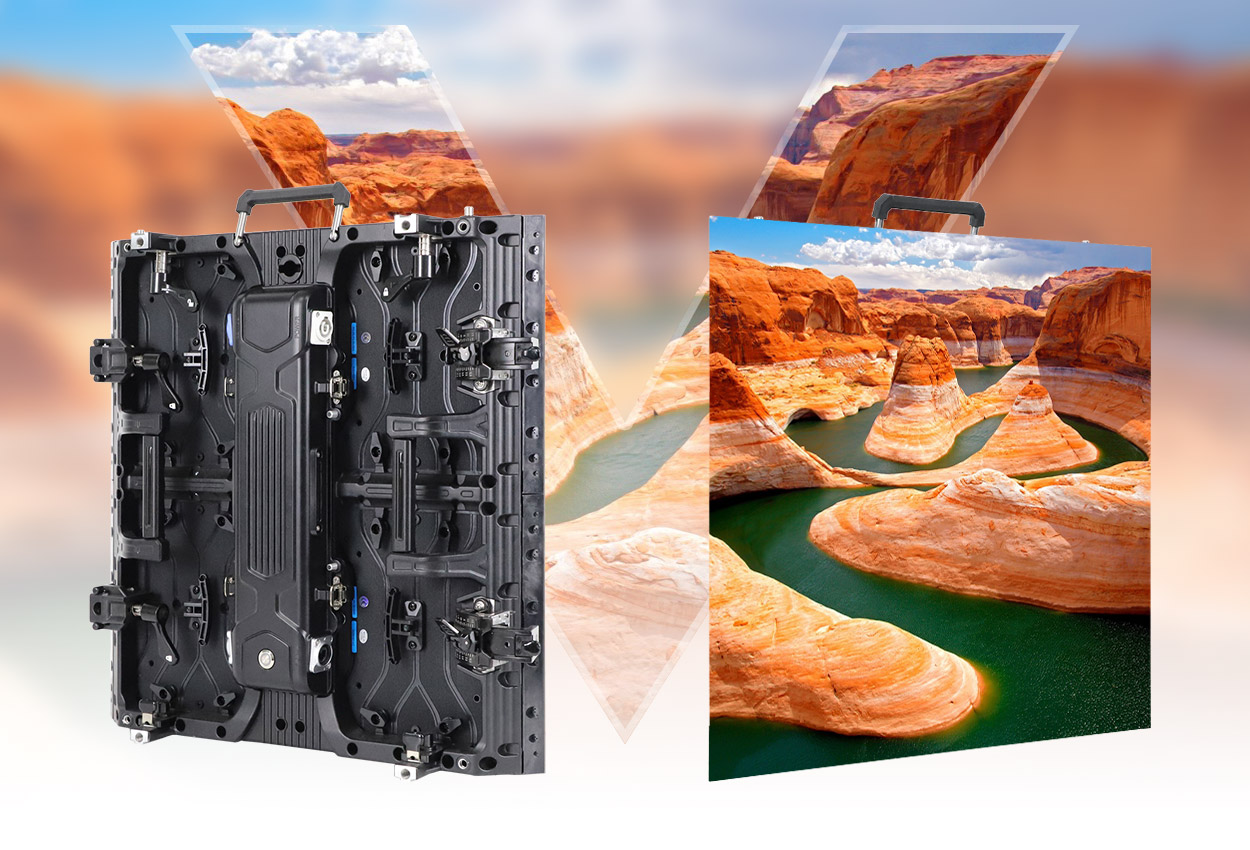
Trade show LED wall cost by booth feature
| Booth feature | Cabinet | Indoor P2.6 GOB | Indoor P2.97 | Indoor P1.95 GOB |
|---|---|---|---|---|
| Flat back wall | EA1000H9, 500 × 1000 mm | US$456 per cabinet (US$912 per m², US$85 per sq ft) | US$381 (US$762 per m²) | US$591 (US$1,182 per m²) |
| Corners and cubes | EA500H8V, 500 × 500 mm | US$305 (US$1,220 per m², US$113 per sq ft) | US$266 (US$1,064 per m²) | US$375 (US$1,500 per m²) |
| Curves and cylinders | EA500H7, 500 × 500 mm | US$316 (US$1,264 per m², US$117 per sq ft) | US$285 (US$1,140 per m²) | US$395 (US$1,580 per m²) |
Reference ex-factory prices from the EagerLED Aug 2026 price list, in USD, for the standard configuration; final pricing is subject to a formal quotation. These are purchase prices for cabinets an exhibitor or rental company owns, not hire rates, and exclude processing, cases, rigging, freight and labour. Per-m² figures divide the cabinet price by its area.
Visitors at a booth often walk to within 2–3 m of the wall, so P2.6 is a sensible minimum and P1.95 GOB suits product close-ups and small text. The pixel pitch and viewing distance guide explains how to choose, and rental LED panel purchase cost compares every rental cabinet family.
LED wall size by booth size
| Booth | Suggested screen | EA1000H9 cabinets | P2.97 | P2.6 GOB | Resolution at P2.6 |
|---|---|---|---|---|---|
| 3 × 3 m inline booth | 3 × 2 m (9.8 × 6.6 ft) back wall | 6 × 2 = 12 | US$4,572 | US$5,472 | 1152 × 768 |
| 6 × 6 m booth | 6 × 3 m (19.7 × 9.8 ft) back wall | 12 × 3 = 36 | US$13,716 | US$16,416 | 2304 × 1152 |
| 10 × 10 m island | 8 × 3 m (26.2 × 9.8 ft) feature wall | 16 × 3 = 48 | US$18,288 | US$21,888 | 3072 × 1152 |
Keep the bottom of the screen above the heads of visitors standing in the booth, usually by mounting it on a riser or plinth, and check the hall’s maximum build height before choosing the screen height. An island booth often adds a cube or column so the brand is visible from every aisle.
Flat booth back wall: a 6 × 3 m example
| 6 × 3 m (19.7 × 9.8 ft), 18 m² (194 sq ft) | Cabinets | P2.97 | P2.6 GOB | Weight |
|---|---|---|---|---|
| EA1000H9, 500 × 1000 mm | 12 × 3 = 36 | US$13,716 | US$16,416 | about 432 kg (952 lb) at 12 kg each |
| EA500H8V, 500 × 500 mm | 12 × 6 = 72 | US$19,152 | US$21,960 | about 461 kg (1,016 lb) at 6.4 kg each |
At P2.6, the wall is 2304 × 1152 pixels in either format, a 2:1 canvas that suits wide brand graphics; agree with the content team how 16:9 video will sit on it.
The tall EA1000H9 needs half as many cabinets, which means fewer locks, power and data connections and a faster build. EagerLED describes it as light enough for two people to lift and align by hand, with a die-cast aluminium frame, handles, locating slots, corner protection, magnetic modules and a detachable rear power box. It also builds stepped and staggered edges when mixed with the smaller EA500H9.
Corners, cubes and curves
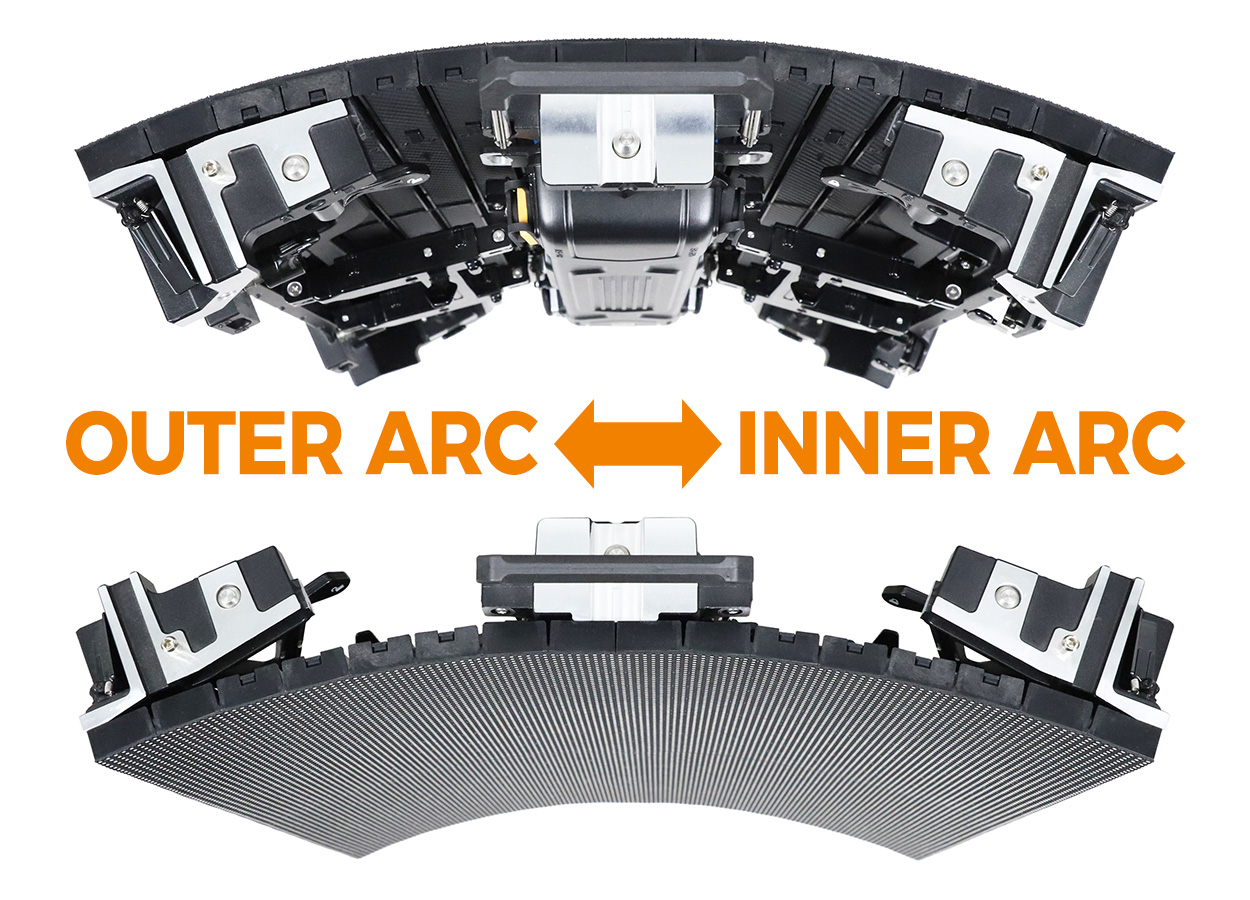
Corners and cubes. The EA500H8V has 45-degree bevelled cabinet edges that form 90-degree corners and cube displays, and arc locks for curved walls. A 1 m (3.3 ft) cube with four faces of 2 × 2 cabinets uses 16 cabinets and costs about US$4,880 at P2.6 GOB or US$4,256 at P2.97. Its magnetic modules come out from the front, and the power box detaches at the rear.
Curves and cylinders. The EA500H7 uses flexible modules and a sliding adjustment mechanism to set concave, convex and cylindrical shapes. A column 8 cabinets around (4 m circumference, about 1.27 m or 4.2 ft across) and 6 cabinets high uses 48 cabinets and costs about US$15,168 at P2.6 GOB; confirm with the supplier that the cabinet’s curve range reaches that radius. Each EA500H7 cabinet weighs 7 kg and has four foldable corner protectors for handling.
Repeatable curves. If the same curved backdrop has to be rebuilt at show after show, EA1000H9’s optional arc locks index each cabinet to a set angle, repeat the radius on the next build and can close into a ring. Order arc locks with the cabinets.
Weight and limited rigging
Exhibition halls often limit what can be hung from the roof, charge for rigging points, or allow only ground-stacked walls. Work out the total weight early: the 6 × 3 m wall weighs about 432–461 kg before the support frame, cables and processor. Ask the hall for its rigging rules and approval process, and have the stand builder’s engineer sign off the support structure.
Smaller 500 × 500 mm cabinets weigh less each (6.4 kg indoor for EA500H8V) and are easier to carry through narrow aisles, but a wall needs twice as many. Larger cabinets build faster. Choose by the build time you are allowed and the handling route from the loading dock.
Quick setup and flight cases
Build days at trade shows are short. Ask for packed case dimensions, loaded case weight and how many cabinets each case holds, plus spare modules, spare power boxes, receiving cards and any corner or curve hardware. Pack the corner and curve hardware with the cabinets that use it, and label every case with its position in the wall. Keep cabinets, control, spares, cases and freight on separate lines so you can compare LED screen quotes on the same inclusions.
Service access depends on where the wall stands. A wall backed against the booth’s rear partition can only be serviced from the front, so check that modules and power boxes can be reached from the side you will have.
Camera and phone video at the booth
Visitors film booths on their phones, and many exhibitors stream product launches. EA1000H9 lists at least 3,840 Hz refresh with 14-bit greyscale, and EA500H8V at least 3,840 Hz with 14-bit greyscale and a 140° viewing angle. Test the finished wall with a phone camera and any streaming camera before the hall opens.
Content for a booth wall
A booth wall is seen in passing, so content works best as short loops with large brand graphics and few words. Build it at the wall’s native resolution: a 2:1 or 3:1 canvas needs its own layout rather than a stretched 16:9 video. Plan a playback device that starts automatically when the wall powers up each morning, and keep a spare copy of the content on site.
Hire or buy for exhibitions
One or two shows a year usually favour hiring, because the hire company carries transport, storage and crew. Stand builders, agencies and companies on a full exhibition calendar can compare the purchase prices above with hire quotes. The LED screen rental price guide explains what a hire quote includes and how to work out a break-even, and the LED screen price overview puts rental cabinets beside fixed walls.
Trade show LED wall checklist
- Draw the booth with every screen face, corner and curve, and mark visitor positions.
- Choose pitch from the closest visitor position and the smallest text.
- Get the hall’s rigging rules and the total weight before choosing the support method.
- Confirm corner and curve hardware, service side and spare parts for each cabinet type.
- Request case dimensions, loaded weights and build time for the exact cabinet count.
- Test the finished wall with phone and streaming cameras before opening.
Frequently asked questions
How much does a trade show LED wall cost?
To own, a 6 × 3 m booth wall costs US$13,716–US$16,416 in EA1000H9 cabinets or US$19,152–US$21,960 in corner-capable EA500H8V cabinets. Hiring is quoted per show by the rental company.
What size LED wall fits a trade show booth?
It depends on the booth and the hall’s height limit. A 6 × 3 m wall suits a back wall on a 6 m booth front; smaller booths often use a 3 × 2 m wall or a 1 m cube.
What pixel pitch is best for a trade show?
P2.6 for walls viewed from 3 m or more, and P1.95 GOB when visitors stand close to read product detail.
Can an LED wall be hung in an exhibition hall?
Only with the hall’s approval. Many halls limit hanging loads, so ground-stacked walls are common. The 6 × 3 m wall weighs about 432–461 kg before its frame.
Can LED cabinets build corners and curves?
Yes, with the right cabinet: EA500H8V for 90-degree corners and cubes, EA500H7 for flexible curves and cylinders, and EA1000H9 arc locks for repeatable curved walls.
How much does a small booth LED wall cost?
A 3 × 2 m back wall for a 3 × 3 m inline booth uses 12 EA1000H9 cabinets and costs about US$4,572 at P2.97 or US$5,472 at P2.6 GOB to own, before processing, cases and freight.
Should an exhibitor hire or buy a booth LED wall?
Hire for one or two shows a year, when the rental company carries transport, storage and crew. Buying starts to make sense for stand builders, agencies and companies with a full exhibition calendar, once you can compare real hire quotes with the purchase price and your own transport and storage costs.
How long does it take to build a booth LED wall?
It depends on the cabinet count, the support method and the crew. Larger cabinets cut the number of connections, so ask the supplier for a build time for your exact layout and check it against the hall’s build schedule.
Send your booth drawing, show dates and venue rules to request a quote.
Check the details
Sources & references
Source pages can change. Access dates record when they were consulted.
- EA500H8V specs Accessed 29 October 2026
- EA500H7 specs Accessed 29 October 2026
- EA1000H9 specs Accessed 29 October 2026
Put these details into your project brief.
Tell EagerLED the application, destination and screen dimensions you have in mind.
Request a project quote