Quick answer
An LED video wall is one large screen built from LED cabinets that lock together edge to edge. A video processor takes your picture from a laptop, media player or camera and spreads it across every cabinet, so the wall shows one continuous image with no bezels. Because it is modular, it can be built to almost any width and height in steps of one cabinet.
Sources used: EagerLED LED video wall guide; Video wall screens: LED vs LCD; LED wall price scope; EA640F2 specifications
What it costs depends mainly on size and pixel pitch. For a 16:9 indoor wall built from EagerLED’s 640 × 480 mm EA640F2 cabinets, the screen costs:
| 16:9 wall size | Cabinets | P3.076 | P2.5 | P1.86 GOB | P1.25 GOB |
|---|---|---|---|---|---|
| 2.56 × 1.44 m (8.4 × 4.7 ft), 116 in | 4 × 3 = 12 | US$2,168 | US$2,521 | US$3,189 | US$5,585 |
| 5.12 × 2.88 m (16.8 × 9.4 ft), 231 in | 8 × 6 = 48 | US$8,670 | US$10,086 | US$12,755 | US$22,340 |
| 7.68 × 4.32 m (25.2 × 14.2 ft), 347 in | 12 × 9 = 108 | US$19,508 | US$22,693 | US$28,699 | US$50,264 |
Reference ex-factory prices from the EagerLED Aug 2026 price list, in USD, for the standard configuration; final pricing is subject to a formal quotation. Per square foot that is about US$55 at P3.076, US$64 at P2.5, US$80 at P1.86 GOB and US$141 at P1.25 GOB.
These are screen prices. The video processor, the mounting structure, electrical work, freight and installation come on top, and on a permanent installation they can add a large share to the total.
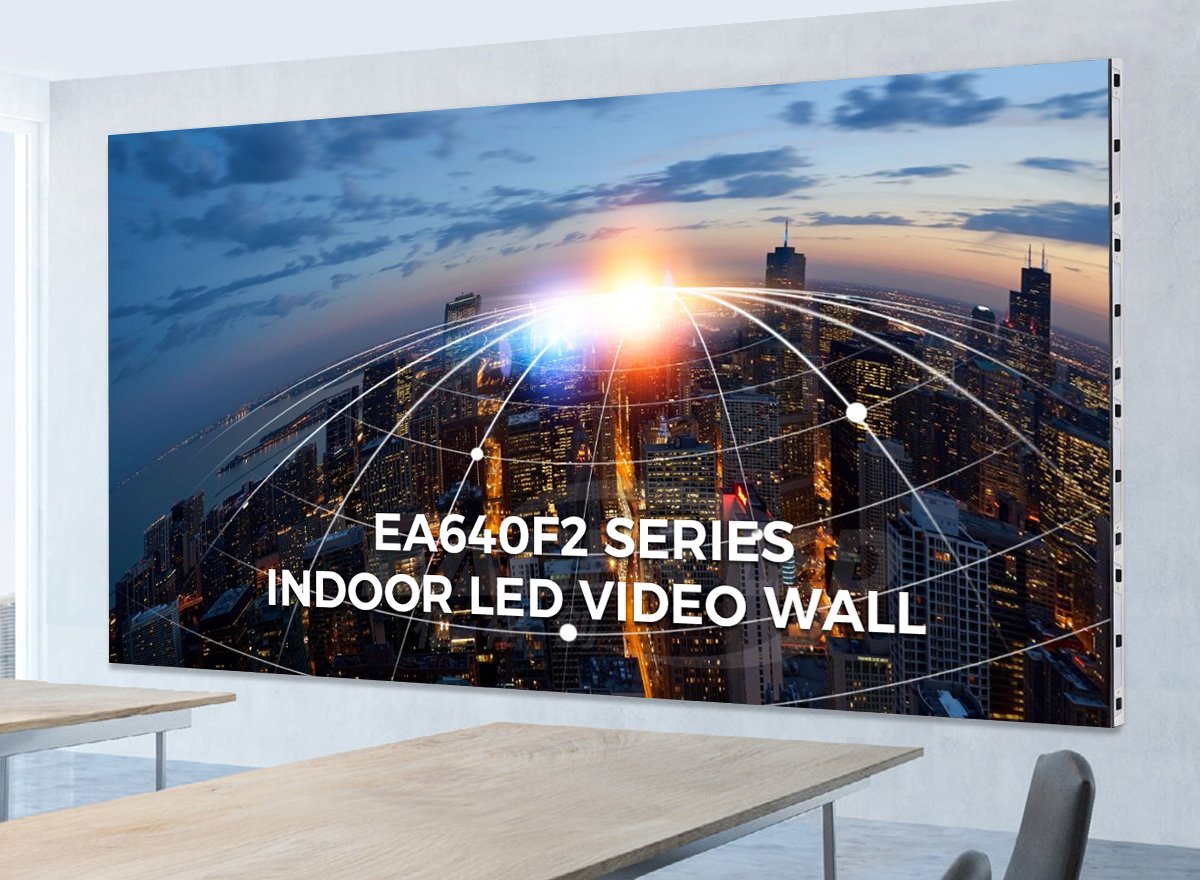
What an LED video wall is
The building blocks are small. LED modules carry the pixels, and several modules fit into a cabinet. Each cabinet also holds power supplies and a receiving card that takes data from the cabinet next to it. Cabinets bolt or lock together into the full wall, and the processor feeds the picture into the first cabinet of each data chain.
EagerLED’s LED video wall guide stresses that the screen is only one part of the system. A working wall also needs the controller or video processor, signal and power cabling, a mounting structure and a content source, and the processor must handle the wall’s native pixel count and the inputs you plan to use.
People search for the same thing under different names: LED video wall, video wall LED, LED wall or direct-view LED. “Video wall” on its own is a broader term. It also covers walls of tiled LCD monitors and blended projectors, which work differently:
| Technology | Best fit | Main strength | Main trade-off |
|---|---|---|---|
| Direct-view LED wall | Large indoor or outdoor screens, unusual shapes | Seamless image at almost any size, bright enough for daylight | Fine pitches get expensive; needs power, structure and service planning |
| Tiled LCD video wall | Controlled indoor rooms with detailed dashboards | High pixel density in standard panel sizes | Bezel lines cross the image; panel sizes are fixed |
| Blended projection | Very large temporary or theatrical surfaces | Can cover unusual surfaces | Needs dark rooms; shadows and alignment drift |
This summary follows EagerLED’s comparison of video wall technologies. The cost and detail trade-off between LED and LCD at the same size is worked through in LED vs LCD video wall.
The parts of an LED video wall system
When you compare quotes, check which of these parts each one includes. A screen-only quote normally covers the modules, cabinets, power supplies and receiving cards, as EagerLED’s LED wall price guide explains, but confirm the scope in writing because some offers bundle more.
| Part | What it does | In a screen-only price? |
|---|---|---|
| LED modules | Carry the pixels; replaced one at a time if they fail | Yes |
| Cabinets | Hold modules, power and data, and lock to their neighbours | Yes |
| Power supplies and receiving cards | Sit inside each cabinet | Usually; confirm |
| Video processor or sending controller | Takes HDMI or other inputs, scales the picture and maps it to the cabinets | No |
| Media player or PC | Plays the content | No |
| Mounting structure | Wall frame, floor stand or flown rigging | No |
| Site electrics | Circuits, distribution and protection for the wall | No |
| Spares | Spare modules, power supplies and receiving cards from the same batch | Ask |
| Installation and calibration | Assembly, alignment, colour and brightness set-up, training | No |
Size the processor from the wall’s pixel count, not its physical size. The 5.12 × 2.88 m wall at P2.5 is 2048 × 1152 pixels, or about 2.36 million. Sending equipment is rated in pixels per output port, and about 650,000 pixels per gigabit port at 60 Hz is a common figure, so this wall needs four outputs. A 3840 × 2160 wall has 8.3 million pixels and needs about 13. Check the rating of the actual controller you are offered.
LED video wall sizes for 720p, 1080p and 4K
A wall’s resolution comes from its width in millimetres divided by the pitch. That gives a simple check: to get 1920 pixels across (Full HD), a wall must be at least 1.92 m wide for every millimetre of pitch. At P2.5 that is 4.8 m (15.7 ft); at P1.25 it is 2.4 m (7.9 ft). For 3840 pixels across (4K UHD) double it: 7.68 m at P2, or 4.8 m at P1.25.
The EA640F2 cabinet is 4:3, so four cabinets across and three high make a 16:9 wall of 2.56 × 1.44 m, and multiples of that stay 16:9. The EA640F2 specification documents this 4 × 3 layout and gives each module’s pixel matrix, which is how the resolutions below are worked out (each cabinet holds 2 × 3 modules):
| Pitch and price per m² | 2.56 × 1.44 m | 5.12 × 2.88 m | 7.68 × 4.32 m |
|---|---|---|---|
| P3.076 (US$588) | 832 × 468 | 1664 × 936 | 2496 × 1404 |
| P2.5 (US$684) | 1024 × 576 | 2048 × 1152 | 3072 × 1728 |
| P2 GOB (US$830) | 1280 × 720 | 2560 × 1440 | 3840 × 2160 |
| P1.86 GOB (US$865) | 1376 × 774 | 2752 × 1548 | 4128 × 2322 |
| P1.53 GOB (US$1,096) | 1664 × 936 | 3328 × 1872 | 4992 × 2808 |
| P1.25 GOB (US$1,515) | 2048 × 1152 | 4096 × 2304 | 6144 × 3456 |
The two pitches not in the price table above cost US$3,060, US$12,239 and US$27,537 at P2 GOB for the three sizes, and US$4,040, US$16,161 and US$36,363 at P1.53 GOB.
Three points follow from the table:
- A 16:9 shape is not the same as Full HD. The small P2 wall is 16:9 but only 1280 × 720 pixels. Quote the native pixel count, not the aspect ratio.
- Native resolution rarely matches the source exactly. A 2048 × 1152 wall shows a 1080p feed either scaled up slightly or pixel for pixel with a narrow border. For the sharpest result, make content at the wall’s own resolution.
- A finer pitch is not always worth it. On the 5.12 × 2.88 m wall, P1.25 costs US$22,340 against US$10,086 at P2.5. That buys 4K-class detail, which pays off only if people sit close or read small text. The 2K, 4K and 8K resolution guide goes further into pixel counts.
How to choose pitch, size and brightness
Pitch follows the nearest viewer and the smallest text. As a starting point:
| Pitch | Typical nearest viewer | Typical rooms |
|---|---|---|
| P3.076 | about 3 m (10 ft) and beyond | Churches, auditoriums, stages, large lobbies |
| P2.5 | about 2.5 m (8 ft) | Lobbies, retail, classrooms, event rooms |
| P1.86–P2 | about 2 m (6.5 ft) | Meeting rooms and training rooms |
| P1.25–P1.53 | 1.5 m (5 ft) or closer | Boardrooms, control rooms, close reading of small text |
Test your real content at the real distance before you decide. The pixel pitch and viewing distance guide explains the method.
Size follows the farthest viewer. For presentations, a common AV rule of thumb is a screen height of about one-sixth of the distance to the farthest seat. A room whose back row is 17 m (56 ft) away needs a wall about 2.88 m (9.4 ft) high, which is the 5.12 × 2.88 m size.
Brightness follows the light in the room. Indoor cabinets like the EA640F2 are rated at 600–800 cd/m², and most rooms run them well below that. Outdoor and sun-facing walls need outdoor cabinets of 4,500 cd/m² or more; the outdoor LED screen price guide covers them.
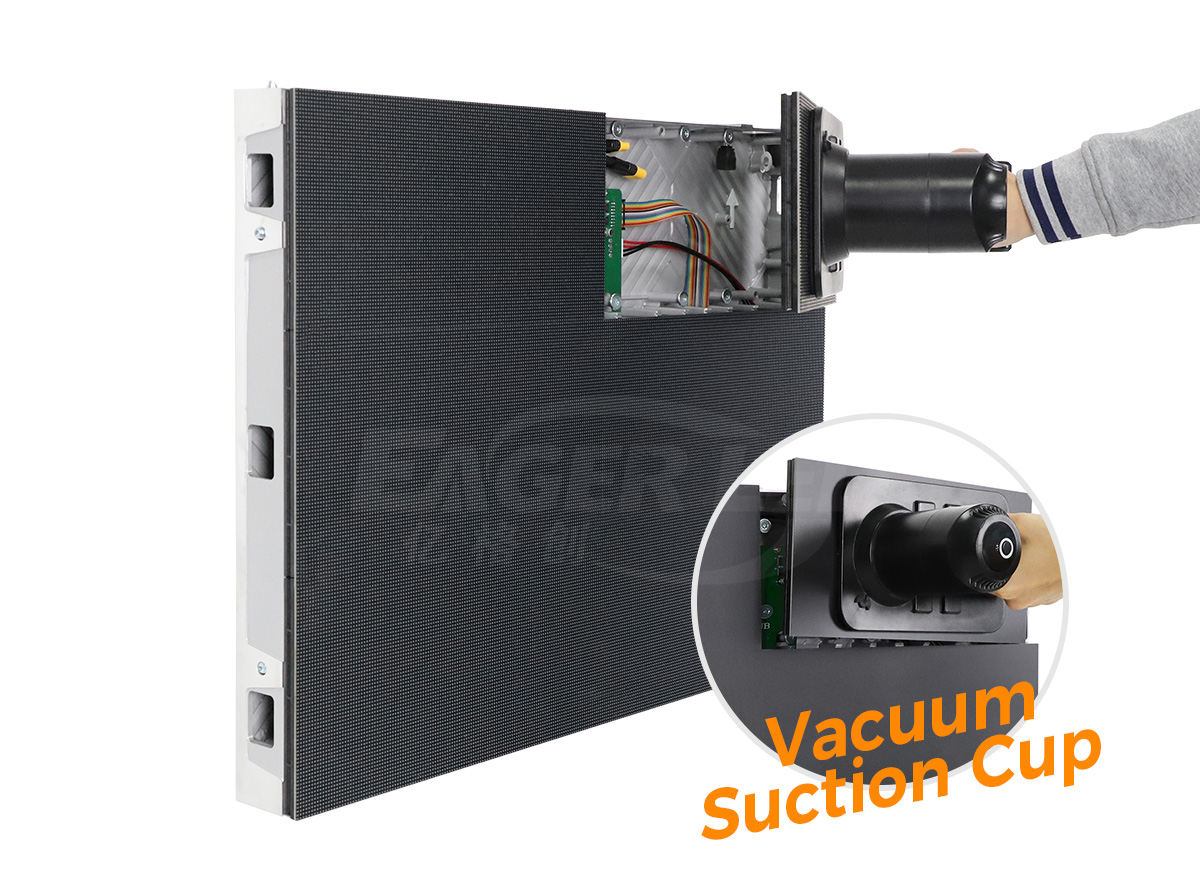
Service access follows the wall position. A wall fixed flat against a building wall needs front service. The EA640F2 is 60 mm deep, weighs 7.5 kg per cabinet, and gives front access to its modules, power supplies and receiving cards, which is why it suits walls with no space behind them.
LED video wall cost by application
Each use has its own priorities, so the same wall size can end up with a different cabinet and pitch. These screen prices come from the detailed guides on this site:
| Application | Example wall | Screen price | Detailed guide |
|---|---|---|---|
| Meeting or conference room | 4.20 × 2.36 m (13.8 × 7.8 ft), COB | US$13,554 at P1.87 | Hybrid conference room LED screen |
| Corporate lobby | 4.00 × 2.00 m (13.1 × 6.6 ft) | US$6,840 at P2.5 | Lobby LED wall |
| Church sanctuary | 5.12 × 2.88 m (16.8 × 9.4 ft) | US$8,670–US$14,908 at P3.076–P2 | Church LED wall cost |
| Control room | 6 m (19.7 ft) wide | US$13,750–US$22,966 at P1.86–P1.25 GOB | Control room LED wall |
| Theater or stage backdrop | 6.00 × 3.50 m (19.7 × 11.5 ft) | about US$15,897 at P2.6 | Theater stage LED screen |
| Events, bought for repeat use | 4 × 3 m (13.1 × 9.8 ft), rental cabinets | US$12,480 at P2.6 | LED screen rental |
| Outdoor advertising | 4.80 × 2.88 m (15.7 × 9.4 ft) | about US$6,898 at P8 | Outdoor LED screen price |
For a one-off event, hiring usually costs less than buying; the rental guide sets out what a hire quote includes and when owning starts to pay.
Power use and running cost
LED walls are rated with two power figures. Average power sets the electricity bill; maximum power sets the circuit size. The EA640F2 at P2.5 is listed at 100 W per m² average and 300 W per m² maximum.
For the 5.12 × 2.88 m wall (14.75 m², 158.7 sq ft) that is about 1.47 kW average and 4.42 kW maximum. Running 10 hours a day, it uses about 5,400 kWh a year, roughly US$810 at an assumed electricity rate of US$0.15 per kWh. Have the electrician size the supply from the maximum figure. The average vs maximum power comparison shows why the two differ so much.
What to budget beyond the screen
The screen price is the part you can compare across suppliers most easily, but a finished wall includes:
- Processing and playback. The video processor or sending controller, a media player or PC, and any software licences.
- Structure. A wall frame, floor stand or rigging, designed for the wall’s weight and checked by a qualified installer.
- Electrical. Circuits sized from the maximum power, distribution and protection.
- Freight and import. Packing, shipping, insurance, duties and local taxes, with the delivery terms stated.
- Installation. Labour, access equipment, alignment, calibration, commissioning and operator training.
- Spares and support. Spare modules and power supplies from the same production batch, the warranty terms and who carries out repairs.
How these lines add up on a real project is covered in hardware vs installed cost, and long-term costs in shipping, maintenance and running cost.
LED video wall quote checklist
Ask every supplier for:
- Wall width and height, cabinet count and cabinet model.
- Native resolution in pixels, and the pixel matrix of one module.
- Pitch, LED type (SMD, GOB or COB) and brightness at the setting you will use.
- Average and maximum power per m² and for the whole wall.
- Refresh rate, and a camera test if the wall will be filmed or streamed.
- Front or rear service, and the clearance needed for it.
- Processor model, its pixel capacity and inputs.
- Spare parts included, and the warranty terms in writing.
- Delivery terms, and which installation work is in the price.
To compare quotes line by line, use the LED screen quote comparison guide.
Frequently asked questions
How much does an LED video wall cost?
For the screen, a 16:9 indoor wall of 2.56 × 1.44 m (8.4 × 4.7 ft) costs about US$2,168–US$5,585 and one of 5.12 × 2.88 m (16.8 × 9.4 ft) US$8,670–US$22,340, from P3.076 to P1.25 GOB. The processor, structure, electrical work, freight and installation are extra.
What size LED video wall gives 1080p or 4K?
Divide the width in millimetres by the pitch. For 1920 pixels across, the wall must be at least 1.92 m wide per millimetre of pitch: 4.8 m at P2.5 or 2.4 m at P1.25. For 4K UHD (3840 pixels across) it must be 7.68 m wide at P2 or 4.8 m at P1.25.
Is an LED video wall better than an LCD video wall?
LED is seamless, brighter and can be any size, so it suits large screens, mixed light and audiences across a room. A tiled LCD wall gives finer detail per panel at lower cost but always shows bezel lines, which suits close-viewed dashboards in controlled rooms.
What is included in an LED video wall package?
A screen-only quote normally includes the modules, cabinets, power supplies and receiving cards. The video processor, media player, mounting structure, site electrics and installation are usually extra, so check each item before comparing totals.
How much power does an LED video wall use?
At P2.5, the EA640F2 is listed at 100 W per m² average and 300 W per m² maximum. A 5.12 × 2.88 m wall therefore averages about 1.47 kW and peaks at 4.42 kW. Use the maximum for the electrical design.
Should I rent or buy an LED video wall?
Rent for occasional events; buy for a permanent installation or frequent events. For repeat use, compare the cost of several hire quotes over the period with the purchase price plus storage, transport, crew and spares.
Check the details
Sources & references
Source pages can change. Access dates record when they were consulted.
- EagerLED LED video wall guide Accessed 12 November 2026
- Video wall screens: LED vs LCD Accessed 12 November 2026
- LED wall price scope Accessed 12 November 2026
- EA640F2 specifications Accessed 12 November 2026
Put these details into your project brief.
Tell EagerLED the application, destination and screen dimensions you have in mind.
Request a project quote