Quick answer
A mini jumbotron is a small four-sided video screen that hangs from the ceiling, like the scoreboard over an arena floor scaled down for a man cave, home bar, sports bar, gym or church youth room. Some are four TVs in a box frame; the others are built from LED cabinets, so each face is one seamless screen.
Sources used: EagerLED jumbotron buying guide; EA600COB3 specifications; EA500H8V specifications; EA640F2 specifications; LED screen cube face mapping guide; LED sports ticker planning guide
For an LED build, the screen for all four faces costs:
| Face size (each of four faces) | Cabinets | Build and pitch | Screen price, four faces |
|---|---|---|---|
| 1.2 × 0.675 m (3.9 × 2.2 ft), 54 in, 16:9 | 16 | EA600COB3 COB, P1.87–P1.25 | US$4,426–US$5,660 |
| 1.28 × 0.96 m (4.2 × 3.1 ft), 63 in, 4:3 | 16 | EA640F2, P3.076–P1.86 GOB | US$2,890–US$4,252 |
| 1.0 × 1.0 m (3.3 × 3.3 ft), square, beveled corners | 16 | EA500H8V, P2.97–P1.95 GOB | US$4,256–US$6,000 |
| 1.8 × 1.0125 m (5.9 × 3.3 ft), 81 in, 16:9 | 36 | EA600COB3 COB, P1.87–P1.25 | US$9,958–US$12,736 |
| 1.92 × 1.44 m (6.3 × 4.7 ft), 94 in, 4:3 | 36 | EA640F2, P3.076–P1.86 GOB | US$6,503–US$9,566 |
| 2.56 × 1.44 m (8.4 × 4.7 ft), 116 in, 16:9 | 48 | EA640F2, P3.076–P1.86 GOB | US$8,670–US$12,755 |
Reference ex-factory prices from the EagerLED Aug 2026 price list, in USD, for the standard configuration; final pricing is subject to a formal quotation.
These are screen prices. The box frame, a ceiling hanging point rated for the load, a video processor or sending card, the electrical supply and installation come on top. For a home, the 54 in and 63 in rows are the usual starting point; the 94 in and 116 in faces suit gyms, large bars and small arenas.
What a mini jumbotron is
The name borrows from the center-hung video boards in arenas, which show the game on four faces so every seat has a view. A mini version keeps the shape and shrinks it to fit a room with an ordinary ceiling height.
There are two ways to build one, and they are often sold under the same name. EagerLED’s jumbotron buying guide separates a modular direct-view LED display from a home mini-jumbotron made of several televisions, and advises comparing viewing distance, native resolution, room brightness, service access and installation before choosing either.
- TV build. Four flat TVs face outward from a box frame. With one TV per face, the TV bezels meet at the four corners. Each TV takes its own signal, unless a splitter feeds the same picture to all four.
- LED build. Each face is made of LED cabinets that lock together edge to edge, so the face has no bezel lines. A processor or sending card drives all four faces from one source, and faces can be any size in whole cabinets.
The arena-sized version, with prices for 6 m to 20 m boards, is covered in the jumbotron guide. This guide stays with screens small enough for a room.
Mini jumbotron sizes and prices
LED cabinets come in fixed sizes, so a face is a whole number of cabinets across and down. Three EagerLED cabinet families give the three common face shapes.
4:3 faces on EA640F2. The EA640F2 cabinet is 640 × 480 mm, 60 mm deep and 7.5 kg, with front service. Two across and two high give a 1.28 × 0.96 m face; three by three gives 1.92 × 1.44 m; four across and three high gives a 16:9 face of 2.56 × 1.44 m.
| Face size | Cabinets (four faces) | P3.076 | P2.5 | P1.86 GOB | Pixels per face at P2.5 |
|---|---|---|---|---|---|
| 1.28 × 0.96 m (4.2 × 3.1 ft) | 16 | US$2,890 | US$3,362 | US$4,252 | 512 × 384 |
| 1.92 × 1.44 m (6.3 × 4.7 ft) | 36 | US$6,503 | US$7,564 | US$9,566 | 768 × 576 |
| 2.56 × 1.44 m (8.4 × 4.7 ft) | 48 | US$8,670 | US$10,086 | US$12,755 | 1024 × 576 |
Per square foot of screen that is about US$55 at P3.076, US$64 at P2.5 and US$80 at P1.86 GOB.
A 4:3 face is not wasted on 16:9 sport. On a 1.28 × 0.96 m face, a full-width 16:9 picture is 0.72 m high, which leaves a 0.24 m band for the score, clock or sponsor line, the way arena boards mix video and graphics.
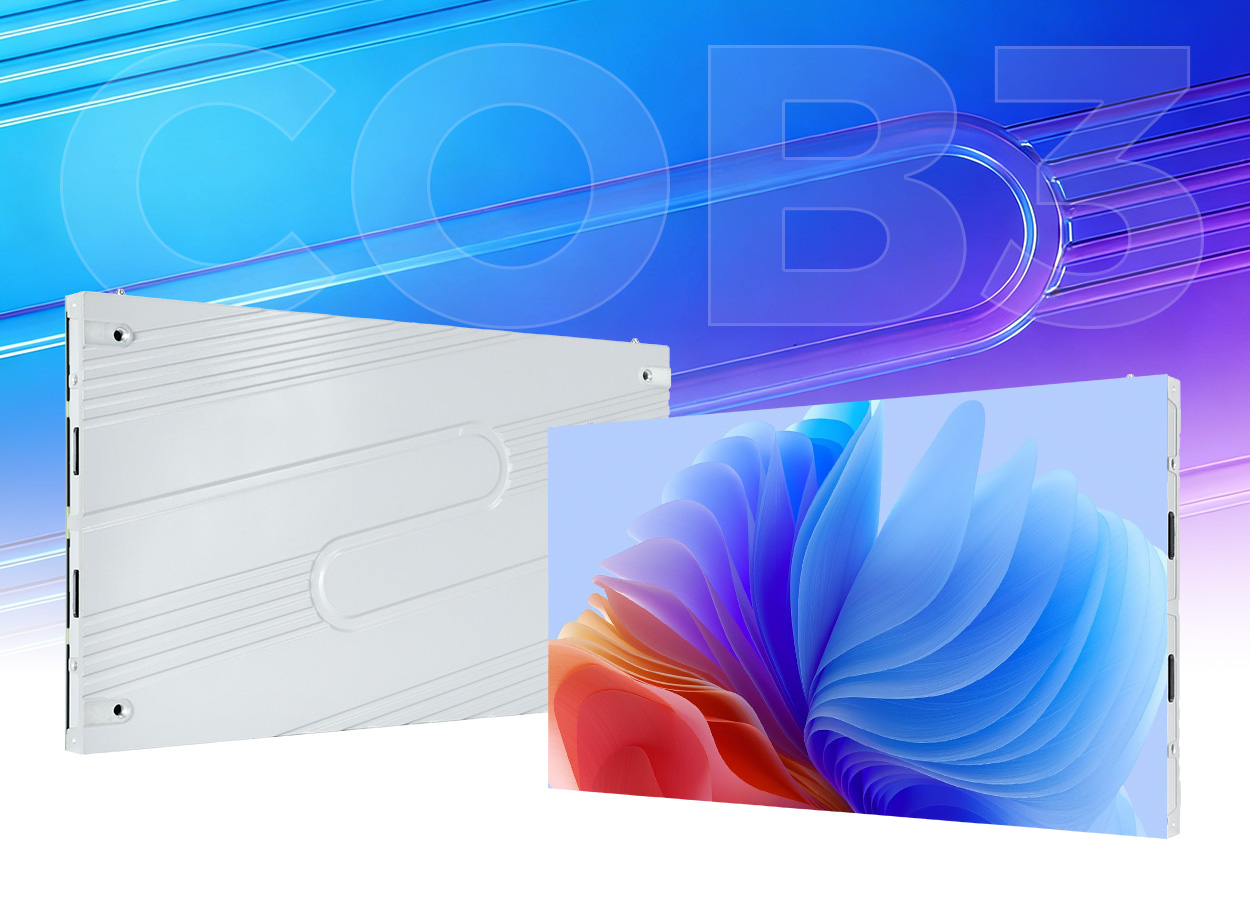
16:9 faces on EA600COB3. The EA600COB3 cabinet is a 16:9 COB cabinet of 600 × 337.5 mm, 30 mm deep and 4.1 kg. Two by two gives a 54 in face; three by three gives an 81 in face, the size of a large TV.
| Face size | Cabinets (four faces) | P1.87 COB | P1.25 COB | Pixels per face |
|---|---|---|---|---|
| 1.2 × 0.675 m (3.9 × 2.2 ft), 54 in | 16 | US$4,426 | US$5,660 | 640 × 360 at P1.87, 960 × 540 at P1.25 |
| 1.8 × 1.0125 m (5.9 × 3.3 ft), 81 in | 36 | US$9,958 | US$12,736 | 960 × 540 at P1.87, 1440 × 810 at P1.25 |
That is about US$127 per square foot at P1.87 and US$162 at P1.25. COB costs more per square metre, but it is the finer, tougher surface for a screen people walk under and look at from a sofa. The COB vs SMD comparison explains the difference.
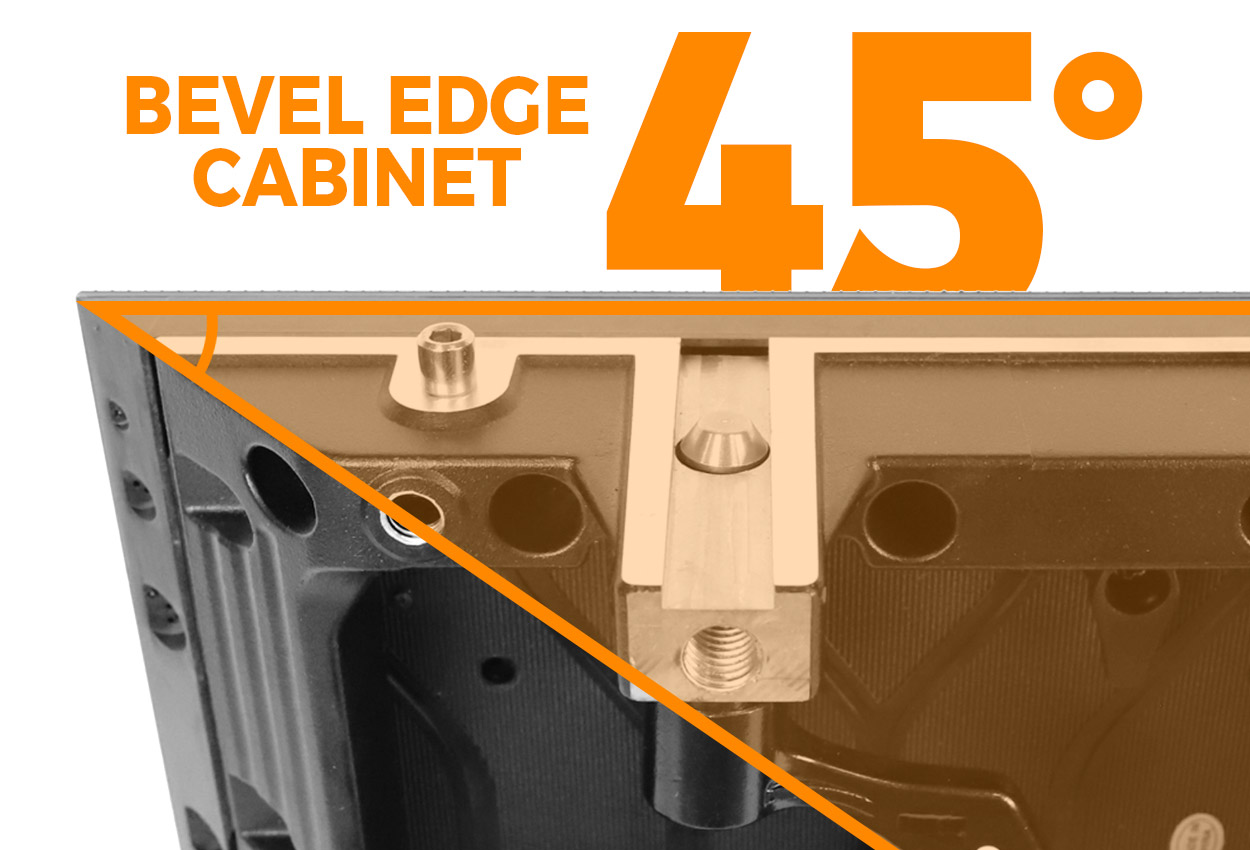
Square faces with clean corners on EA500H8V. On flat cabinets, the four faces meet at the corners with a frame or trim strip. The EA500H8V has a 45-degree beveled cabinet edge, so two cabinets on adjacent faces form a 90-degree display corner, and EagerLED lists cube builds as one of its uses. Its quick locks also make it easy to take down and rebuild, which suits a gym or event space where the display moves.
| Face size | Cabinets (four faces) | P2.97 | P2.6 GOB | P1.95 GOB | Pixels per face at P2.6 |
|---|---|---|---|---|---|
| 1.0 × 1.0 m (3.3 × 3.3 ft) | 16 | US$4,256 | US$4,880 | US$6,000 | 384 × 384 |
| 1.5 × 1.5 m (4.9 × 4.9 ft) | 36 | US$9,576 | US$10,980 | US$13,500 | 576 × 576 |
EA500H8V cabinets are priced per cabinet (US$266 at P2.97, US$305 at P2.6 GOB and US$375 at P1.95 GOB), and the square faces suit scores and graphics more than full-width 16:9 video.
LED vs TV mini jumbotron
A TV build is the cheaper way to start if a single TV size per face is enough. The LED build makes sense when the faces must be seamless, larger than TVs come, or brighter than the room.
| Point | TV build | LED build |
|---|---|---|
| Face surface | One TV per face; bezels at every corner, and across the picture if a face uses several TVs | One seamless surface per face; corners can be trimmed or beveled |
| Face size | Limited to TV sizes | Any size in whole cabinets |
| Picture | High pixel count in a small face | Fewer pixels per face at the same size; pitch sets the detail |
| Brightness and angle | Glass front can reflect lights; some panels fade off-axis | Matte LED surface; EagerLED lists a 140-degree viewing angle on these cabinets |
| Service | Replace the whole TV | Replace one module from the front |
| Signal | Four sources, or one splitter | One processor or sending card for all faces |
| DIY level | Frame, mounts and cables | Frame plus licensed electrical work and a configured controller |
TV prices change too often to quote here. If you compare a TV kit with an LED quote, match the face size and include the frame in both. The same trade-off at wall scale is set out in LED vs LCD video wall.
Pixel pitch for a man cave, bar or gym
Pixel pitch is the distance between pixels, and it decides how close people can sit before they see dots. A mini jumbotron hangs above head height, which adds distance, but in a basement the nearest seat can still be under 3 m away.
The EA600COB3 specifications give a working rule for text and data: P1.25 and P1.56 suit about 2 to 3 m, and P1.87 about 3 to 4 m. Wider pitches serve rooms where the nearest viewer is farther away.
| Room | Nearest viewer | Pitch | Build |
|---|---|---|---|
| Basement or man cave | 2–3 m (7–10 ft) | P1.25–P1.56 | EA600COB3 COB |
| Large den or home bar | 3–4 m (10–13 ft) | P1.86–P1.87 | EA600COB3 P1.87 or EA640F2 P1.86 GOB |
| Sports bar or restaurant | 3–5 m (10–16 ft) | P1.86–P2.5 | EA640F2 |
| Gym, youth room or small arena | 5 m (16 ft) or more | P2.5–P3.076 | EA640F2 or EA500H8V |
For the full chart and formula, see pixel pitch and viewing distance. For a bar where the screen sits among TVs and low light, the restaurant and bar LED screen guide covers brightness settings.
Weight, hanging and power
A mini jumbotron is a suspended load over people, so weight and hanging come first.
| Build | Cabinets | Screen weight before the frame |
|---|---|---|
| 54 in faces, EA600COB3 | 16 × 4.1 kg | About 66 kg (145 lb) |
| 1.0 m square faces, EA500H8V | 16 × about 6.4 kg | About 102 kg (226 lb) |
| 63 in faces, EA640F2 | 16 × 7.5 kg | About 120 kg (265 lb) |
| 81 in faces, EA600COB3 | 36 × 4.1 kg | About 148 kg (325 lb) |
| 94 in faces, EA640F2 | 36 × 7.5 kg | About 270 kg (595 lb) |
The frame adds to this. A load like this cannot hang from a light fitting or ceiling drywall. It needs a hanging point fixed to the building structure, checked by a structural engineer or qualified rigger, with a secondary safety cable. Leave enough clearance underneath for the tallest person in the room to walk past, and plan a way to lower the screen or reach the modules for service.
Power is lower than the size suggests. At P2.5 the EA640F2 is listed at 100 W per m² average and 300 W per m² maximum. The EA600COB3 lists 75 W per m² average and 220 W per m² maximum at P1.87, and 95 and 280 W per m² at P1.25.
| Build | Average | Maximum | Maximum current at 120 V | Running cost, 4 hours a day |
|---|---|---|---|---|
| 54 in faces, EA600COB3 P1.87 | 0.24 kW | 0.71 kW | About 6 A | About US$53 a year |
| 63 in faces, EA640F2 P2.5 | 0.49 kW | 1.47 kW | About 12 A | About US$108 a year |
| 94 in faces, EA640F2 P2.5 | 1.11 kW | 3.32 kW | About 28 A | About US$242 a year |
Running costs assume US$0.15 per kWh. Size the circuit from the maximum figure: the 94 in build needs more than one 120 V circuit or a 220–240 V supply. The average vs maximum power comparison explains why the two figures differ.
Content and control for four faces
Decide first what the four faces should show. EagerLED’s LED screen cube face mapping guide describes three modes for a four-sided display:
- The same picture on every face, the usual choice for one game in a man cave.
- Different content on each face, for example several games or a menu in a bar.
- One continuous wrap, where an animation runs around all four sides.
The same guide recommends labelling the faces A, B, C and D clockwise as seen from above, and testing with an image that shows large face letters and an upward arrow, so a rotated or mirrored face shows up straight away.
The faces are laid out side by side in one wide canvas. With four 54 in faces at P1.25 (960 × 540 each), the canvas is 3840 × 540, which fits inside a single 4K output. At P1.87 it is 2560 × 360. Ask the supplier to confirm that the processor can show the same input on every face if that is the plan, and to supply the configuration for your exact face layout.
In a sports bar, give the mini jumbotron its own job. EagerLED’s LED sports ticker planning guide suggests keeping the main TVs for the live broadcast and using the extra display for other games, scores and the next fixture. It also advises getting written confirmation that a data or content subscription covers public display in a commercial venue.
Building a DIY mini jumbotron
A TV mini jumbotron is a common DIY project: a steel, aluminium or timber box frame, four VESA mounts, four TVs and a splitter. The hard part is the hanging point, not the TVs.
An LED version needs more than a weekend:
- Cabinets for the four faces, ordered in one batch so colour matches.
- Frame designed around the cabinet mounting points, with the corners resolved by trim or beveled cabinets.
- Controller: a sending card or video processor, configured for the four-face layout.
- Power distribution with the cabinet power cables, installed by a licensed electrician.
- Media source: a cable box, streaming device or PC with the right output.
- Hanging hardware with a rated primary fixing and a safety cable.
- Spare modules so a failed module can be swapped from the front.
Plan the content and run the test pattern on the floor before the screen goes up. A rotated face is much harder to fix once the screen hangs above a bar. What the screen price leaves out is listed in LED video wall installation cost vs hardware price.
Mini jumbotron quote checklist
Send these details to get a quote you can compare:
- Room size, ceiling height and the distance from the screen to the nearest and farthest seat.
- Face size and shape: 16:9, 4:3 or square, and whether the corners must be seamless.
- Content plan: same picture on every face, different content, or a wrap.
- Pixel pitch, and whether COB, GOB or SMD modules are quoted.
- Cabinet count, total screen weight and the power supply (120 V or 220–240 V).
- Processor or sending card model, inputs and four-face configuration.
- Frame and hanging scope: who designs, supplies and certifies them.
- Spare modules, warranty terms and shipping.
To check quotes line by line, use the LED screen quote comparison guide, or request a quote for the cabinets with your face sizes and room drawing.
Frequently asked questions
How much does a mini jumbotron cost?
For an LED mini jumbotron with four 54–63 in faces, the screen costs about US$2,890–US$5,660, depending on cabinet and pitch. Faces of 81–116 in cost about US$6,503–US$12,755. The frame, hanging point, controller, electrics and installation are extra.
How big is a mini jumbotron?
Most have faces of about 1–1.3 m (3–4 ft) wide for a home, and 1.8–2.6 m (6–8.4 ft) wide for a gym, large bar or small arena. LED faces are built in whole cabinets, so sizes step by about 0.5–0.64 m.
Can I make a mini jumbotron from TVs?
Yes. Four TVs in a box frame is the usual DIY build. It costs less to start, but the bezels show at every corner and each TV needs a signal or a splitter. An LED build gives seamless faces and sizes beyond standard TVs.
What pixel pitch does a mini jumbotron need?
Match the pitch to the nearest seat. For a basement or man cave with seats 2–3 m away, choose P1.25–P1.56. For a den or bar at 3–5 m, P1.86–P2.5 works. Gyms and small arenas can use P2.5–P3.076.
How much does a mini jumbotron weigh?
An LED screen with four 54 in faces on EA600COB3 cabinets weighs about 66 kg (145 lb), and four 63 in faces on EA640F2 about 120 kg (265 lb), before the frame. It must hang from a structural fixing with a safety cable.
How much power does a mini jumbotron use?
A four-face 63 in build at P2.5 averages about 0.49 kW and peaks at 1.47 kW, about 12 A at 120 V. At four hours a day and US$0.15 per kWh, that is about US$108 a year.
Check the details
Sources & references
Source pages can change. Access dates record when they were consulted.
- EagerLED jumbotron buying guide Accessed 13 November 2026
- EA600COB3 specifications Accessed 13 November 2026
- EA500H8V specifications Accessed 13 November 2026
- EA640F2 specifications Accessed 13 November 2026
- LED screen cube face mapping guide Accessed 13 November 2026
- LED sports ticker planning guide Accessed 13 November 2026
Put these details into your project brief.
Tell EagerLED the application, destination and screen dimensions you have in mind.
Request a project quote